
Fulbright Chronicles, Volume 4, Number 2 (2026)
Author
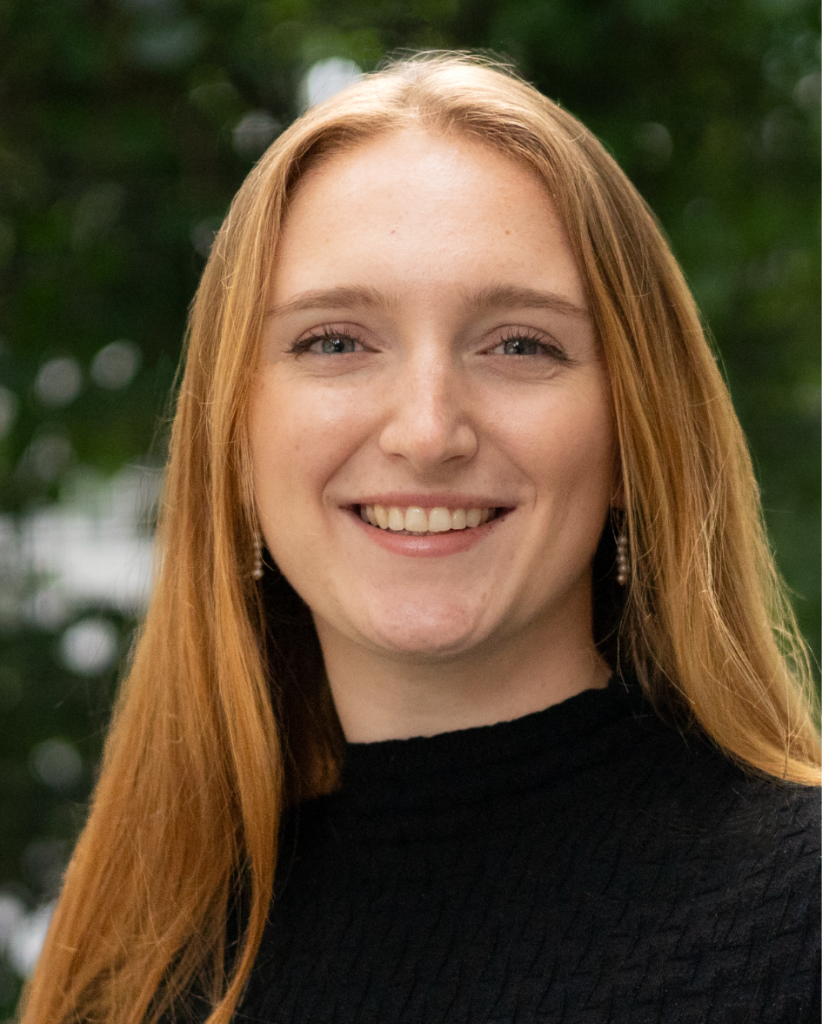
Hailey A. Hesseltine
Abstract
This article reflects on my experience as the first Fulbright English
Teaching Assistant assigned to Ordu, a small city on Türkiye’s
Black Sea coast. It explores what it means to be a yabancı (foreigner),
the power of everyday encounters to create exchange, and the
importance of access to international connection beyond major cities.
By weaving history, community, and personal narrative, it highlights
Fulbright’s quiet but enduring role in fostering curiosity, belonging,
and mutual understanding.
Keywords
Fulbright Program • Türkiye • International education • Cross-cultural exchange • Regional access
I remember opening my email at 4 a.m., cramped in a tiny dorm room with my best friend. It was the day before I would graduate with my master’s degree, and I was living in Hawai‘i, probably the farthest I could be from Türkiye. My “room” could have been mistaken for a storage container: me in a twin-sized bed, my best friend on a borrowed air mattress on the floor. A month earlier, I had been named a Fulbright ETA finalist for Türkiye, and now the only question was where exactly I would be placed.
I’m not sure why I woke up so early that morning. Perhaps nerves about graduation, perhaps a forgotten notification. But there it was: an email from Fulbright. I would be spending my grant year in Ordu. A quick Google search revealed a small coastal city on the Black Sea, its mountains dropping sharply into the sea. A few hours later, my best friend, Turkish herself, woke up, and together we called her father to ask if Ordu was a “good” place. Little did I know then that this placement would be fateful in the best possible way.
Being the first Fulbrighter assigned to Ordu meant both a responsibility and an opportunity: to shape a legacy of English education in the region and to build new bridges of exchange. But it also raised a deeper question: What does it mean to be a yabancı, a foreigner, in this context, and how can Fulbright turn that identity into connection and community across cultural lines?
Ordu, or Altınordu, a city of just over 235,000, is nestled between green mountains and the sea. Mist often hangs over the hills, waves crash against the shore, and steady rain nourishes the fertile soil, which supports the region’s identity and livelihoods. Hazelnut trees dominate the landscape, defining both scenery and seasonal rhythm, as families leave the city each summer to take part in the harvest. Alongside hazelnuts, tea cultivation and fishing sustain the local economy and culture; tea, poured endlessly into tulip-shaped glasses and fresh fish from small boats on the coast define daily life. Türkiye supplies around 70% of the world’s hazelnuts, meaning that to eat them anywhere in the world is often to taste the labor of families from Ordu. And yet, despite this global significance, Ordu remains relatively untouched by foreigners. Tourists are rare, and encounters with outsiders become memorable, even newsworthy. An American teaching at the university naturally sparks curiosity, making Fulbright’s presence here particularly meaningful.
Teaching in Ordu: Classrooms and Curriculum
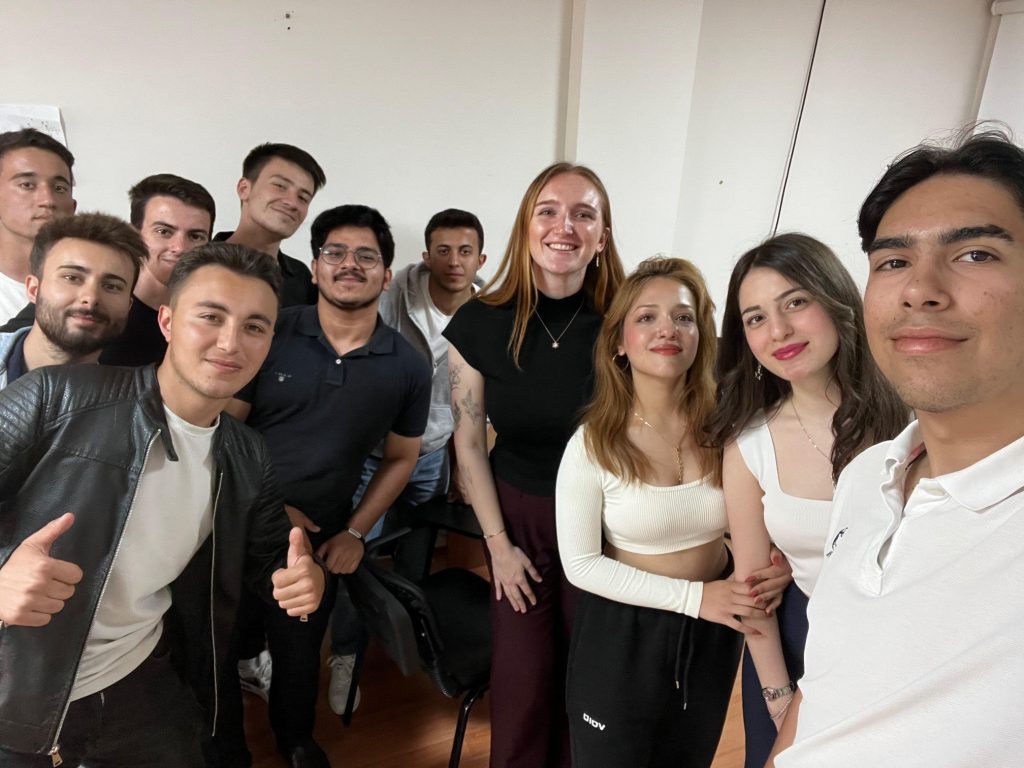
The center of my Fulbright experience was the classroom. I taught 21 hours of speaking-focused English courses each week, split between Maritime students and English Language & Literature students, reaching about 120 students in total. These two groups of learners could not have been more different, and they challenged me to rethink what it means to teach language.
The Maritime students were mostly young men preparing for careers on ships, where English functions as the lingua franca of global navigation. For them, learning English was a practical tool for future employment, not an academic exercise. They were curious but cautious, often reluctant to speak up for fear of making mistakes. Their confidence grew gradually, and the breakthroughs were deeply rewarding, like the first time a student cracked a joke in English and the whole class laughed, or when groups practiced their poster presentations with surprising fluency.
The English Language & Literature students were more academically inclined, eager to discuss pop culture, books, and contemporary global issues. Their English was stronger, but they often relied heavily on written forms. Speaking classes gave them a chance to experiment orally, sometimes stumbling but always eager to push through. They were also the most inquisitive, asking me about politics, U.S. culture, and even my personal life. At times, the questions bordered on being too personal, but I came to see their curiosity as a sign of trust and engagement.
Trust became the defining feature of my classroom. Students told me things they had never told another teacher, perhaps assuming that as a foreigner, I would be less judgmental or less connected to their local community networks. A few students confided in me about their sexuality, something rarely discussed openly in Türkiye. They said they felt safe in my class, that my presence created a small pocket of openness. Others stayed after class simply to talk, to share stories, worries about exams, or dreams for the future. One student even asked me to teach him how to play the ukulele after spotting me playing the instrument in a coworker’s office. These small gestures turned the classroom into more than a space for language. It became a space for trust, creativity, and belonging.
Learning to Teach, Teaching to Learn
Before Fulbright, my professional background had been rooted in student advising and mentorship. I supported high school and university students one-on-one, including many first-generation and international students, as they navigated higher education. In that work, relationships were individualized and progress could be tracked over months of conversation. Teaching 120 students in Ordu was a different challenge entirely. Instead of depth with a few, I needed breadth across many.
I quickly learned that my students’ progress would not come from correcting every grammar mistake but from building confidence. One Maritime student barely spoke at the beginning of the semester, responding only in single words. By spring, he was volunteering answers, even if imperfect. Another student from English Language & Literature began weaving American idioms into his presentations, proud of using expressions I had introduced casually in class. Small shifts like these reminded me that language learning is about courage.
Teaching also forced me to reflect deeply on my own language. Students would ask why we say “on the bus” but “in the car,” or why “read” is spelled the same in past and present tense but pronounced differently. These were questions I had never considered as a native speaker. I found myself researching explanations, breaking down patterns I had always taken for granted. In the process, I became more conscious of the complexity and beauty of the English language. Teaching English in Türkiye taught me more about my own language than any linguistics class ever had.
Perhaps the most meaningful growth came from embracing improvisation. My carefully prepared lesson plans often dissolved when students arrived tired from late-night study sessions or distracted by campus events. I learned to pivot, to turn a student’s offhand comment into a class discussion, to transform a vocabulary mistake into a teaching moment, to let go of rigidity. These skills have made me not just a better teacher, but a more adaptable professional. And because students knew I would listen, they invited me into their world: I attended a soccer match where my students proudly cheered on their classmates, and a play a student of mine acted in, where I sat in the crowded auditorium with my other students as she performed. These moments of showing up mattered. They reminded students I cared about them beyond the gradebook, and in turn, they brought more of themselves into the classroom.
Belonging, Yabancı, and Community
My identity as a yabancı, a foreigner, shaped my life far beyond the classroom. The word itself became a touchstone. Unlike the sometimes-loaded “foreigner” in English, yabancı is often descriptive, even affectionate. Peers might greet me jokingly with “Merhaba yabancı!” or a shopkeeper might pause to remark on my accent. I even had fellow professors point at me in the cafeteria, referring to me as the “yabancı hoca,” foreign teacher, failing to understand that I understood a bit of Turkish myself. Instead of exclusion, it often carried curiosity.
I looked for opportunities to engage with the local community beyond the university. Joining a salsa and bachata course introduced laughter and rhythm that bridged cultural gaps in ways words sometimes could not. I also participated in an English-speaking club at a nearby café, which evolved into leading two-hour discussions on topics ranging from mental health to Hawaiian culture and colonialism. These became spaces of shared curiosity, where I learned as much as I taught.
Local curiosity about my presence extended everywhere, from neighbors bringing food to welcome me, to café owners offering free tea, and to children shouting “hello!” on the street. During Ramadan and Kurban Bayramı, I was invited into homes to share meals and traditions. Each encounter reinforced the sense that Fulbright is not confined to classrooms or research projects. It is lived in daily interactions, in the ordinary rhythms of community life.
Professional and Personal Growth
Fulbright in Ordu shaped me in lasting ways. Personally, I became more independent. Ordu is not a city with a large expat network or endless entertainment options; living there required forging my own routines, navigating bureaucracy, and building relationships from scratch. What might have felt isolating instead became empowering. I learned how to belong by contributing, by saying yes to invitations, by showing up consistently.
Professionally, I discovered how much I value building community through education. I realized that teaching is not separate from advising or mentorship, but serves as another form of guiding people toward opportunities and confidence. This realization was powerful enough that I chose to stay. After completing my Fulbright year, I accepted a position as a lecturer in the same department at Ordu University. This continuity allowed me not only to deepen my work but also to welcome the second Fulbrighter assigned to the city. Watching Ordu shift from having no Fulbrighters to having two, one current and one alumna, was deeply rewarding, a sign that the seeds planted during my year were beginning to grow.
Fulbright also clarified my career trajectory. I had always been interested in international education, but living and working in Ordu showed me that access to cultural exchange matters most. Big cities like Istanbul or Ankara will always attract attention, but smaller cities deserve equal opportunities to connect globally. My time in Ordu convinced me that I want to build a career expanding those opportunities, ensuring students everywhere, not just in privileged centers, can engage internationally.
History, Legacy, and Protecting Access
The Black Sea region has long held strategic importance. During the Cold War, Türkiye’s geography made it a vital buffer between East and West. Soviet claims on Türkiye’s straits in 1946 prompted U.S. policy responses, culminating in the Truman Doctrine and Türkiye’s NATO membership in 1952. One relic of that era is the NATO radar base in nearby Trabzon, established in 1958. Its presence brought cultural exchange: local residents mingled with foreign personnel, recreational clubs emerged, and Western pastimes such as bowling and volleyball became known. Encounters with “the foreigner” became part of social memory, a precursor to the kind of people-to-people diplomacy Fulbright fosters today.
In Ordu, this history still surfaces. People sometimes ask if I am a spy or why an American is teaching here, half joking, half curious. Such questions highlight how rare meaningful interaction with foreigners remains. Fulbright continues this tradition of unexpected exchange, allowing human connections to persist even when global politics shift. One of Fulbright’s quiet strengths is sending grantees to places rarely on the map of international exchange. Before my grant, I had never heard of Ordu. Many students had never interacted with an American. Their perceptions of the U.S. were fragmented, drawn from TV, TikTok, or the news. Simple classroom conversations and cafeteria chats bridged that distance in ways no media could.
Conclusion: Ripples of Exchange
What began as uncertainty transformed into belonging.
Looking back at that cramped dorm room in Hawai‘i, staring at the unfamiliar name “Ordu” on my laptop, I could never have imagined the life that would follow. What began as uncertainty transformed into belonging. Being the first Fulbrighter in Ordu was about showing up, laughing with students in broken Turkish, and creating a visible presence where Americans are rare. Each moment, though small, generated ripples that touched students, colleagues, and neighbors.
Representing Fulbright meant demonstrating that international exchange should not be reserved for privileged cities or institutions. Ordu’s students deserve the same opportunities to engage globally, and Fulbright gave them that. In turn, I grew into a more independent individual, a more reflective teacher, and a more committed professional in international education. Now, with a second Fulbrighter in Ordu, the story continues. The legacy is multiplying, embedding the city more deeply in global networks of exchange. This is Fulbright’s quiet power: it outlives any single individual, sustaining curiosity, connection, and hope in communities far from the spotlight.
Further Reading
- Egemen, B. (2019). Turkish Intelligence and the Cold War: The Turkish Secret Service, the US and the UK. Bloomsbury.
- Erköse, H, Y., Osman Ş., Yükseker, D., & Sert, D. (2020). Between the state and the world market: Small-scale hazelnut production in the Black Sea region. İstanbul University Journal of Sociology, 40(1), 55-77. https://doi.org/10.26650/SJ.2020.40.1.0047.
- İslam, A. (2018). Hazelnut culture in Turkey. Akademik Ziraat Dergisi, 7(2), 259-266. https://doi.org/10.29278/azd.476665.
- Toucas, B. (2017, February 2). The geostrategic importance of the Black Sea region: A brief history. Center for Strategic and International Studies. https://www.csis.org/analysis/geostrategic-importance-black-sea-region-brief-history.
Biography
Hailey A. Hesseltine is a Lecturer in the School of Foreign Languages at Ordu University in Türkiye and was an English Teaching Assistant there during the 2024–2025 cycle. She can be reached at haileyahesseltine@gmail.com.