
Fulbright Chronicles, Volume 4, Number 2 (2026)
Author
Hilary A. Smith
Abstract
For decades I had conducted research abroad primarily in the People’s Republic of China, until a 2024 Fulbright award to Taiwan reoriented my perspective. Living and doing research in Taiwan gave me a new understanding of Chinese history and identity that both shaped my latest book and helped me escape the conflict-centered discourse that dominates conversations about China in the US. This article explains how.
Keywords
China • Taiwan • new Cold War • history • geopolitics
Introduction
Before I arrived in Taipei in January of 2024 as a Fulbright scholar, I would not have identified with the frog in the well. In a Chinese story from the ancient text, a frog looks up from the bottom of a well and, seeing a huge turtle peering down at him from above, begins to boast about how terrific his home is and how he enjoys being master of its mud and water. “Why not come down and join me, turtle?” He asks. But the turtle is much too large to enter the small well. Instead, he tells the frog about his own home, the Eastern Sea, so big that consecutive years of flood or drought don’t perceptibly change the amount of water it holds. The little frog, speechless with amazement, has become a symbol in Chinese cultures of naïve complacency and ignorance of the wider world.
“That is not me,” I’d have said before 2024. I had traveled widely, lived in different parts of the United States and the globe, and developed expertise in Chinese and medical history. But living in Taipei as a visiting scholar at Academia Sinica’s Institute of History and Philology (IHP) reminded me that even a world that feels expansive is just one narrow sliver of existence.
China in American Eyes: From Land of Opportunity to Incipient Enemy
Like many of my colleagues who go to Taiwan, I identify primarily as a China scholar. On an impulse thirty years ago, I signed up for Mandarin 101 in my first semester of college, and by the time the professor had finished demonstrating the four tones, I was hooked. I spent one summer in an immersive language program in Beijing and the next teaching English in Suzhou. I graduated determined to find work that would keep connecting me with China. After returning to the People’s Republic of China (PRC) as a full-time English teacher, I was lucky enough to find my way to graduate school and eventually to a career as a historian. In short, I fell in love with China as a young adult and never looked back.
You may have noticed that everything in that autobiographical sketch was about China, not Taiwan. In the mid-1990s when I started studying Mandarin, Taiwan was an afterthought. Americans were bullish about the PRC despite the shock of the Tiananmen crackdown half a decade earlier. They saw mainland China as dynamic and rising, so that’s where they chose to go for study, research and work. The Chinese citizens I met were optimistic too: their lives and prospects were improving as the economy burgeoned.
Consequently, just about every part of my early education in Chinese language and culture tilted toward the PRC. The university’s brilliant, hard-working language teachers were from the mainland; my Chinese was peppered with the distinctive “arr” sound that Beijingers attach to many word endings. After the first year of study, in which we read and wrote the traditional form of Chinese characters (coincidentally, the form used in Taiwan and much of the Chinese diaspora), our teachers allowed us to choose whether to continue learning traditional or switch to the simplified characters used on the mainland. Most of us switched, not from any conscious affinity for the PRC but because it meant memorizing fewer strokes of the pen.
Since then, times have changed. Over the past five years or so, as China curtailed residents’ and visitors’ movement in the face of the COVID-19 pandemic, and as tensions between the PRC and the US have risen, it has become harder for Americans to envision a China-centered future for themselves. The number of Americans studying in China has dropped dramatically, from around fifteen thousand in the early 2010s to fewer than one thousand in 2024. The number of Chinese students in the US has also declined by many tens of thousands since its peak in 2019, though nearly three hundred thousand still attend American colleges. And Chinese-language enrollments across US universities have been going down too. At the same time, the US has halted both Peace Corps and Fulbright programs on the mainland. Princeton-in-Asia, the one-hundred-and-twenty-year-old organization that facilitated my early teaching experiences in Suzhou and Dalian, stopped sending fellows to the PRC after the pandemic began.
For people like me who make a living learning and teaching about China, it’s hard to maintain morale in the face of all this. But Taiwan reignited my love of Chinese culture, history and language and reinforced my commitment to sharing that passion with students. At the same time, the experience expanded and complicated my understanding of what Chinese identity means and what Chinese history ought to look like.
Loving and Relearning China in Taiwan
Living in Taiwan was a joyful and reinvigorating experience, to an extent that I had not anticipated as I prepared to go. In the lead-up to our departure, a cloud of anxiety appeared virtually every time I talked with colleagues, students and family about the journey my high schooler and I were about to make. Taiwan? They asked. Did I think it was safe? Wasn’t China threatening to invade? Once I arrived, however, I found myself able to be excited about Chinese culture and history again without US-centered geopolitics pervading every conversation. In the time I spent on the island, precisely zero of the many Taiwanese people I chatted with expressed anxiety about a Chinese invasion. It’s not that they were unaware of the ominous changes in mainland political culture since Xi Jinping came to power in 2012—but Taiwan to them was more than just a potential flashpoint in a new Cold War between the US and China. It was home, where they were living full, rich lives.
It was also inspiring to be in a place where a heritage of Chinese knowledge, custom and language thrives in an ever-more-democratic and inclusive society. I loved hearing Taiwanese and Hakka spoken alongside Mandarin not only on the streets but in official subway announcements and TV shows. In January, just before Taiwan’s presidential election, my teenager and I were thrilled to see tens of thousands of enthusiastic citizens gathered for a political rally in front of Taipei’s presidential palace—in a street that used to be named “Long Live Chiang Kai-shek Road” after the dictator who held Taiwan under martial law for decades. Now the street is called Ketagalan Boulevard in honor of an indigenous group. In May, the streets around the legislature filled with protesters trying to stop a bill from passing. It passed, to their disappointment, but the fractious, vibrant political process went on. A taxi driver I spoke with about the protest said, “They just need to get out and vote in the next election.”
To be sure, there are limits to what one can conclude from incidental interactions, and I do not mean to suggest that politics are more harmonious or society is more unified in Taiwan than in, say, the United States. Legislators sometimes throw punches at one another on the floor of the parliament. Resentments sometimes surface between communities who arrived on the island from different places at different times.
Nor do I intend, by celebrating Taiwan’s distinctiveness and diversity, to reinforce a dichotomy between “good Taiwan” and “bad China,” or to suggest that my time in Taiwan reinforced a negative view of the mainland. While Taiwanese colleagues, friends and strangers sometimes expressed consternation about surveillance and the suppression of free speech when I asked about the PRC, just as often the reaction was quite positive. Only rarely did I hear the kind of anxiety about China that I’d grown used to in the US. The people I talked with asked me where I had been on the mainland and told me about their own travels there. Some had businesses and family in the PRC and visited often. They marveled at how rapidly Chinese infrastructure had advanced. In short, just as Taiwanese people viewed Taiwan as more than a pawn in a geopolitical game, most of them spoke of China as more than a big, scary neighbor. Depending on their own background and experiences, people in Taiwan saw mainland China as heritage, threat, inspiration, oppression, family, opportunity—any combination of these, or all of them at once.
The next time someone suggests that it is intrinsically Chinese to be authoritarian or that Confucian cultures are naturally antidemocratic—claims I sometimes encounter in my classes and when I give talks in the community—I can complicate this simplistic notion with a fresh set of counterexamples.
Fulbright’s Enduring Outcomes
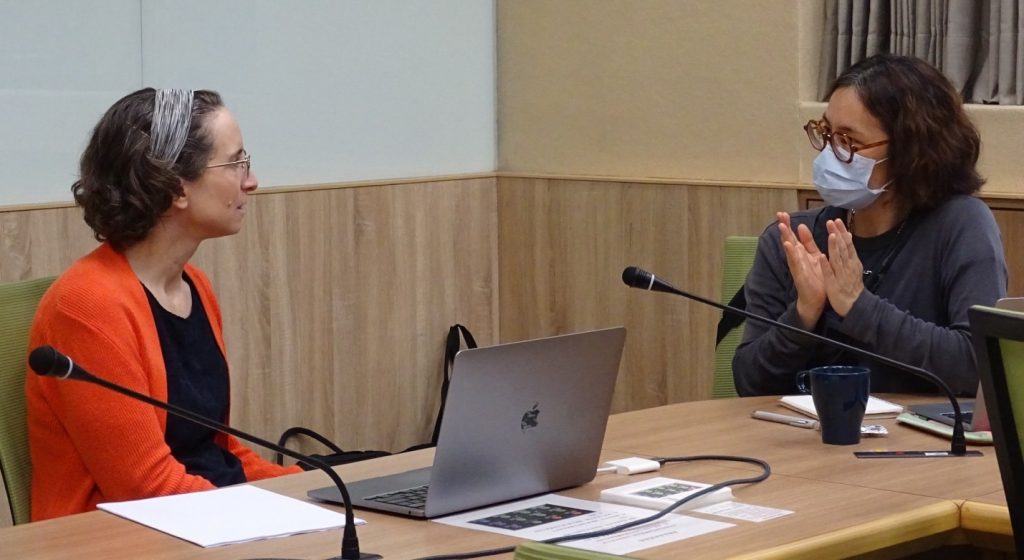
The Fulbright experience changed not only the book I went to Taiwan to complete but also the content of what I teach, reorienting my thinking and building connections that will foster more collaboration in the future. The book, a history of how nutrition science has assessed Chinese bodies and foodways, broadened and gained complexity in Taiwan. From fellow Fulbrighter Miranda Brown, with whom I co-presented a workshop on Chinese dairy history, I learned more about how many premodern Chinese doctors had recommended milk as a health booster, for example. That in turn reshaped the way I wrote about the modern perception that lactose intolerance is a problem for Chinese eaters.
Similarly, the project had originally focused only on China, but in Taiwan, Japan entered the picture too. After I gave a talk on early twentieth-century Chinese nutrition books, Chen Hsiu-fen from National Chengchi University urged me to learn more about the Japanese precedents that the writers had been drawing on. Japanese impact on Chinese science is not something histories published in the PRC tend to emphasize. But Taiwan’s colonial heritage has conferred an understanding of Japan both more intimate and more nuanced than what prevails on the mainland, and there it became more apparent to me how profoundly Japanese voices had influenced Chinese dietetics.
Taiwan itself shows up in the book thanks to the deeper engagement with experts on food and medical history that the grant facilitated. I had not considered Taiwan in my initial conception of the project, probably because I assumed that the story there would differ little from the story in other Chinese communities. But during the Fulbright experience, talking with and reading scholars such as Chen Yu-jen, Pi Kuo-li, and Michelle King, who have all written about Taiwan’s distinctive cultures of food and medicine, made me begin to suspect that Taiwan was necessary to complete the story I had begun to tell. That suspicion became conviction when I stumbled across archival documents about Taiwan’s modern foodways in the library of Academia Sinica’s Institute of Modern History. The documents chronicled how Taiwan had begun to import large amounts of discounted American wheat and dairy after World War II, and how that influx had changed eating patterns. I knew I needed to revise my chapters.
Taiwan’s diverse heritage impacted smaller things about the project too, such as the spelling of names in the book. Originally I wrote all the Chinese names in the manuscript in Hanyu Pinyin, the system for rendering Chinese characters invented in the PRC in the 1950s. But while Pinyin is universal on the mainland, in Taiwan it competes with many different alternative spellings. I initially saw this as a historian’s nightmare—if there is no unified standard, how do you tell whether a name mentioned in one source is the same as a name in another? But gradually Taiwan helped me realize that systems can accommodate a bit of idiosyncrasy without falling apart. I began to accord my historical actors the same respect I accorded living people when it came to choosing their own spelling. Just as I would not correct the residents of 淡水, a Taipei district they spell “Tamsui” but that would be “Danshui” in Pinyin, I stopped writing the name of the scientist 吳憲 “Wu Xian.” Wu himself never used “Wu Xian,” the Pinyin rendering. Instead, when he published in English, he wrote his name “Hsien Wu.” I changed the spelling of his name in the book to honor his choice.
I returned to the US with a better understanding of Chinese cultures, plural, and a new enthusiasm for communicating that plurality. Taiwan opened my eyes to ways in which people construct identities that include Chinese elements but are not necessarily defined by them, ways of being Chinese and. Or as some Taiwanese observers have put it, reversing the PRC’s political claim that Taiwan is a part of China: culturally and historically speaking, China is part of Taiwan.
Back at my home institution, the University of Denver, I am picking away at the conflict-shaped mold that discussions of Taiwan and China get poured into these days. The person-to-person exchanges that Fulbright encouraged gave me new Taiwanese friends both inside and outside of the academy, friends I continue to chat with weekly online. That has allowed me to better understand how history and politics play out on the ground in East Asia. When the Taiwanese government threatened to deport residents who had migrated from the mainland but not officially cancelled their PRC household registration, my friend He Pei, who’d grown up in the PRC and moved to Taiwan as an adult, was able to explain more precisely what that meant and whom it affected. Such conversations help me give students a different kind of insight than they get from news reports.
I now work more deliberately to embed an appreciation of Chinese plurality and diversity in my teaching. Before, Taiwan showed up as a single lesson in my class on modern China, and I had focused on the perspectives of governments: the PRC’s, Taiwan’s, the US’s, and the UN’s. Now, I am building a class that focuses on the voices of dissenters and includes Taiwan as more than just a day: we will hear from and about the intellectuals purged in the anti-Rightist movement on the mainland but also the Taiwanese intellectuals suppressed in Taiwan’s White Terror in the same period. We will examine not only the unsuccessful Tiananmen protests of 1989 but also the successful Wild Lily protests in Taiwan the following year. I also aspire to give US students more-direct access to varied voices by connecting them online with my Chinese and Taiwanese colleagues’ students, and ultimately, perhaps, by taking them abroad for an in-person experience.
The Fulbright ethos of building relationships between individuals—the frog-by-frog approach—offers hope.
Like Zhuangzi’s frog, many Americans currently have a limited view. We see news articles, editorials and political speeches flitting across our circle of sky and infer from them what China is. But the example of Taiwan shows that the world will always be more complex than we could grasp even if we were perched at the top of the well, much less from its bottom. The Fulbright ethos of building relationships between individuals—the frog-by-frog approach, one might call it—does more than revitalize discouraged China scholars like me. It also offers hope for a more-fruitful future involving the US, China, and Taiwan.
Further Reading
- Andrade, T. (2010). How Taiwan became Chinese: Dutch, Spanish, and Han colonization in the seventeenth century. Columbia University Press.
- Gadsden, A. E. (2024, March 5). Studying in China may have gotten harder for Americans, but we shouldn’t stop trying. ChinaFile. https://www.chinafile.com/reporting-opinion/viewpoint/studying-china-may-have-gotten-harder-americans-we-shouldnt-stop-trying
- Institute for International Education. (2024, November 18). United States hosts more than 1.1 million international students at higher education institutions, reaching all-time high. https://www.iie.org/news/us-hosts-more-than-1-1-million-intl-students-at-higher-education-institutions-all-time-high/
- Kuo, M., & Wu, A. (n.d.). A broad and ample road [Blog]. Substack. https://ampleroad.substack.com
- Rigger, S. (2014). Why Taiwan matters: Small island, global powerhouse. Rowman & Littlefield.
Biography
Hilary A. Smith is Associate Professor of History at the University of Denver. She was a Fulbright U.S. Scholar at the Institute of History and Philology, Academia Sinica, Taiwan in 2024. The book she completed while a Fulbright scholar is Nutritional Imperialism: How Science Turned Difference into Sickness in China, forthcoming from Johns Hopkins University Press. She can be reached at hilary.smith@du.edu. Learn more about her work at https://udenver.academia.edu/HSmith.