
Fulbright Chronicles, Volume 4, Number 2 (2026)
Author
James E. Crimmins
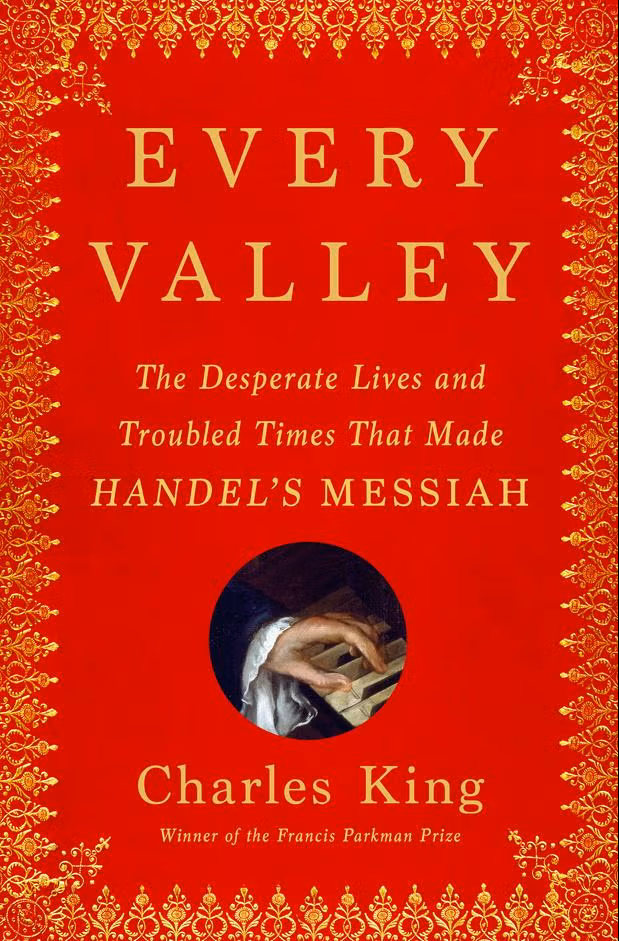
Every Valley: The Desperate Lives and Troubled Times That Made Handel’s Messiah by Charles King who was a Fulbright Scholar in 2013 to Zambia.
We know a good deal about Handel’s life and career as the preeminent composer of the age, while Jennens has virtually disappeared from the Messiah story.
Without Charles Jennens (1700-73), an amateur librettist and sometime editor of Shakespeare, George Frideric Handel (1685-1759) would not have composed Messiah, arguably the greatest oratorio ever produced. They were on different sides in the royal political divide of the day. The one, a non-juror who would have welcomed the return of the Stuarts, the other, a beneficiary of Hanoverian largesse. But this did not prevent a long if fragile friendship and a collaboration that produced the oratorios Saul (1735-39), Israel in Egypt (1739), L’Allegro il Penseroso ed il Moderato (1740-41), Messiah (1741-42), andBelshazzar (1744-45), among others. Each derived from Jennens’s deep knowledge of the Old and New Testaments. Messiah stands out not only due to the scale of Handel’s innovative and intricate composition of music and voices but also because Jennens’s script, on which it is based, presents a “dramatized philosophy” of “the cosmic meaning of the prophetic birth, suffering, and resurrection of Jesus Christ” and an affirmation of the “staggering possibility” that despite the swirling chaos and conflict of the times “the world might turn out alright” (3-5). The whole crowned by the uplifting “Hallelujah” chorus. Yet, Jennens’s name rarely featured on the title page. Consequently, we know a good deal about Handel’s life and career as the preeminent composer of the age, while Jennens has virtually disappeared from the Messiah story.
Charles King rectifies this omission in his wide-ranging history of the people and events that shaped the context in which Messiah was crafted and performed. Chapters are devoted to the religious and political turmoil caused by the Jacobite threat; the dawn of the Enlightenment produced by the works of intellectuals such as Locke, Leibniz, Bayle, Hume, and Voltaire; the popularity of literary satires and parodies like Swift’s Gulliver’s Travels and Pope’s Dunciad; Britain’s colonization of North America and the horrendous slave trade from which so many made their fortunes; the plight of women in an entirely misogynistic society; the emergence of charitable foundations to assist the poor and indigent; and the evolution of musical styles and the culture of theatrical celebrity. King weaves together insights in all these topics to produce a rich panoply of ideas and action that sheds a powerful light on the creation and performance of the most celebrated musical production of the eighteenth century.
Jennens was a country squire whose family had made a fortune from the iron industry in Birmingham. Educated at Oxford, he was a devout Christian who immersed himself in the sacred texts. He never married, living a gentleman’s life at Gopsall Hall in Leicestershire surrounded by his extensive collection of paintings, sheet music, and books, and gaining a reputation as a generous patron of the arts, though his occasional despondency and irascibility made friendships difficult. Jennens’s fervor for Handel’s early baroque compositions brought him into contact with the transplanted German, and he began supplying his new friend with the unsolicited libretti that stimulated the composer’s imagination. Jennens wasn’t always happy with what Handel made of his scripts, including Messiah, as his correspondence makes plain, frequently sending corrections and suggestions, some of which were adopted, but there can be no doubt that without Jennens’s contribution, Messiah would never have come into existence.
The intertwined lives of other notables who had a bearing on the work’s creation and performance are also explored by King, among them Jonathan Swift; William Hogarth; the monarchs Queen Anne and the first two Georges; the philanthropist Thomas Coram; the slave prince Ayuba bin Sulay Diallo; and some of the musicians and singers with whom Handel worked, not least the immensely talented Susannah Cibber, the long suffering wife of the scurrilous Theophilus Cibber, son of the actor and theatre mogul Colley Cibber. Susannah Cibber enjoyed an illustrious stage career but her place in King’s tale is as the emotive contralto soloist in the premiere of Messiah in Dublin in 1742, for which she gained rave reviews. There was some criticism of Handel, mainly for mixing scripture and stagecraft—it wasn’t until 1750 that the work was performed in a religious setting (the chapel of the Foundling Hospital) but from that point on, Messiah became a regular fixture in London’s calendar of musical events.
King’s book is written in an accessible style with an acute eye for detail, bringing together a knowledge of philosophy, musical form, social and political history, and scriptural exegesis. Anyone who has listened to Messiah will feel instructed by this book, and for those who have yet to experience it, were they to read King’s study, they will almost certainly seek out the oratorio to enjoy in all its moving glory.
Charles King, Every Valley: The Desperate Lives and Troubled Times that Made Handel’s MESSIAH. New York, NY: Doubleday, 2024. 335 pages,. US $32.00.
Biography

James E. Crimmins earned his first two degrees from the University of Wales (Swansea) and now lives in Canada where he was awarded a doctorate from Western University. He is Professor Emeritus and Research Fellow at Huron University College (Western). In 2012-13, he was Fulbright Visiting Research Chair at Vanderbilt University and has been the recipient of many other awards and fellowships. His numerous published articles and books in the history of political thought include most recently Utilitarianism in the Early American Republic (Routledge 2022), The Bloomsbury Encyclopedia of Utilitarianism (Bloomsbury 2013, pbk 2017), and Utilitarian Philosophy and Politics: Bentham’s Later Years.