
Fulbright Chronicles, Volume 4, Number 1 (2025)
Author
Narun Pat

Abstract
As a leading program chair of Brain Informatics 2024 in Bangkok, I witnessed the power of global interdisciplinary collaboration between neuroscience and computer science. Trained as a cognitive neuroscientist with Fulbright support, I experienced firsthand how these fields converge to advance our understanding of the brain. Hosting the conference in Thailand also highlighted the country’s growing potential in artificial intelligence (AI) and cognitive neuroscience, a promising sign for the region’s scientific future.
Keywords
Fulbright • Thailand • cognitive neuroscience • interdisciplinary collaboration • artificial intelligence
With Fulbright support, I trained as a cognitive neuroscientist at the Department of Psychology, Northwestern University (Evanston, IL) from 2009 to 2015. Cognitive neuroscience explores the neural mechanisms underlying cognitive functions. Early developments in artificial intelligence (AI) were heavily inspired by neuroscience and psychology, evident in concepts like neural networks and reinforcement learning. However, during my PhD, AI remained largely the domain of computer science, with limited integration into cognitive neuroscience. At the time, it felt only tangentially relevant to our field.
Fast forward to 2025, and AI has become more commonly incorporated into cognitive neuroscience research. For instance, our laboratory at the University of Otago in New Zealand (https://sites.google.com/view/hamneurolab/) has applied AI to predict cognitive processes from large-scale neuroimaging data. This progress has been made possible in part due to long-standing interdisciplinary collaborations between neuroscientists and computer scientists, leading to recent breakthroughs.
Conferences: Catalysts for Neuroscience – AI Collaboration
Brain Informatics (BI) (https://braininformatics.springeropen.com/) is an academic journal that exemplifies the interdisciplinary collaboration between neuroscientists and computer scientists. Each year, Brain Informatics hosts the International Conference on Brain Informatics (BI), which brings together experts from neuroscience and computer science fields worldwide. Since its inception in 2006, the conference has been held in various countries across the globe, including China, Canada, Japan, Poland, the UK, Italy, Australia, and the USA.
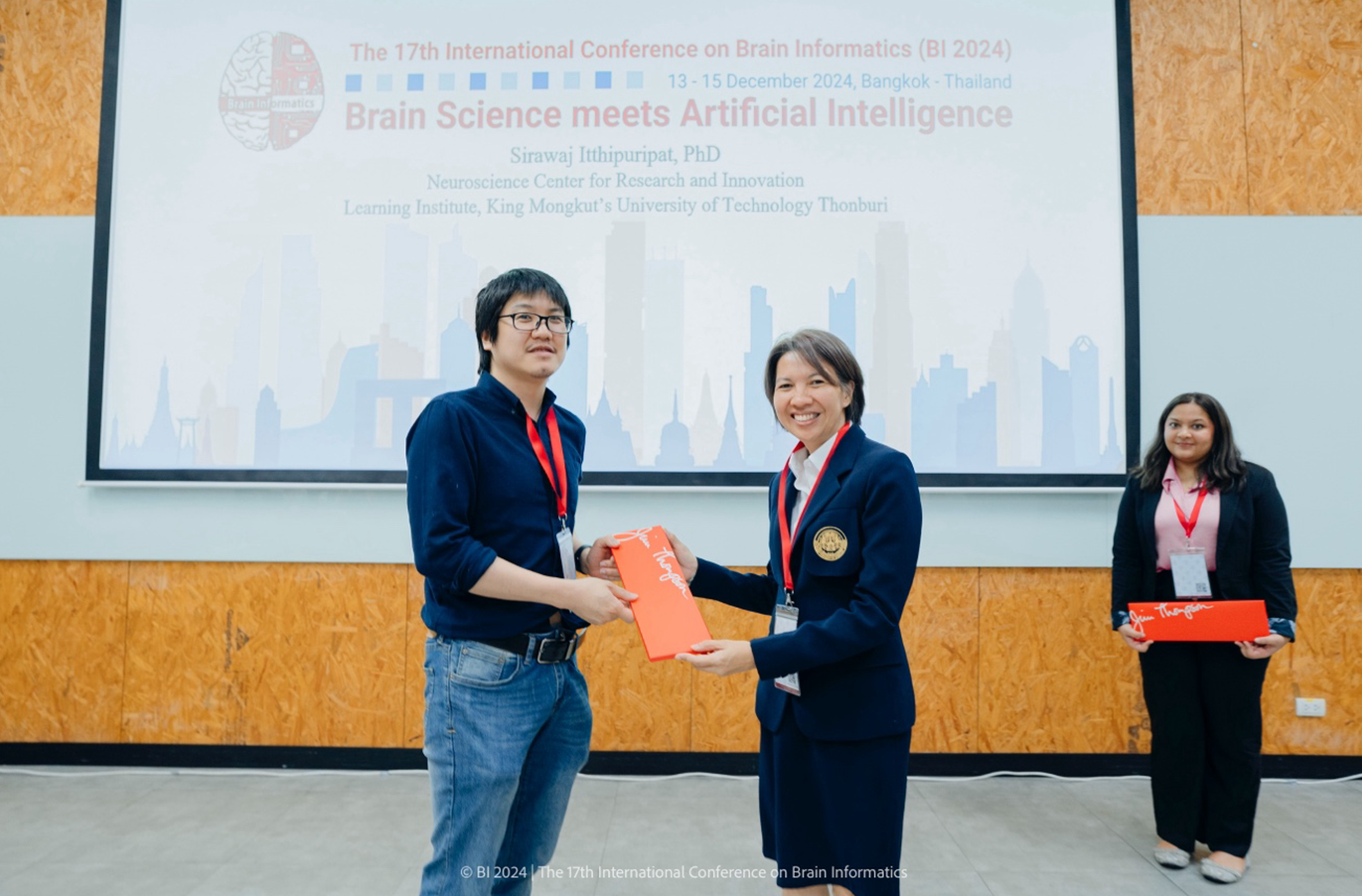
For its 17th conference, BI 2024 was held in my hometown, Bangkok, Thailand. The event was sponsored by international organizations such as the Institute of Electrical and Electronics Engineers (IEEE) Computer Society, the Web Intelligence Consortium, The International Neural Network Society, and the Chinese Society for Cognitive Science, along with private industries such as Springer and BioSemi. Local sponsors included King Mongkut’s University of Technology Thonburi.
The conference featured speakers and attendees from various countries, representing both the Global South and Global North. The interdisciplinary nature of the conference attracted a wide range of expertise across computer science and cognitive neuroscience, covering topics from theoretical modeling to animal models and robots, whole-brain morphometry, graphical modeling of brain networks, and cognitive ontologies. You can view the proceedings here: https://link.springer.com/book/9789819632961.
Cultural Differences in the Conference Organization Between Computer Science and Cognitive Neuroscience
It was an honor and privilege to serve as the leading program chair of BI 2024. Although I had prior experience organizing conferences for neuroscience and psychology, BI 2024 was different. The standard practices were more aligned with computer science than neuroscience or psychology. Coordinating with committee members from Europe, North America, Asia, and Oceania, especially with the time differences, was challenging. However, it was a great learning experience.
For instance, computer scientists seem to value conference proceedings more than neuroscientists, possibly because research in computer science progresses at a faster pace. Participants, particularly those with a computer science background, are often motivated to submit a 9-12 page full paper rather than a 1,500-word abstract. These full papers were peer reviewed for originality, significance of contribution, technical merit, and presentation quality. Accepted full papers were not only presented orally at the conference but also published in a proceedings book series.
This required organizers to find reviewers who could peer review all submitted papers promptly. The reviewing process, including revisions and resubmissions, had to be completed within a couple of months from submission. This ensured that authors were notified in time to prepare for travel to the conference, which might be in a country on the other side of the world. This contrasts with traditional neuroscience/psychology journals, where there is no set timeline for article acceptance and publication. This practice also necessitated an army of experts from various fields who could quickly provide high-quality reviews. Initially, I was concerned about this, as reviewing is a volunteer work, and journal editors often struggle to find expert reviewers willing to sacrifice their weekends and nights for reviews.
In an IEEE conference like BI 2024, the group of experts who review submissions is called the Program Committee or PC. Each submission requires at least two, but ideally three, PCs to review. To my surprise, finding PCs was easier than I expected. We sent emails to previous attendees and our networks of colleagues in neuroscience/psychology and computer science. Despite their busy schedules, many accepted our invitation. They were the unsung heroes who made conferences and academic journals possible.
Given its interdisciplinary nature, another challenge was matching each submission’s content to the appropriate PC’s expertise. Fortunately, the conference team, including Hongzhi Kuai from Maebashi Institute of Technology in Japan, created a computerized system to facilitate this matching. As a program chair, I was grateful for their system, which allowed me to alert PCs to ensure reviews were completed on time.
Most organizers worked for the conference out of love, and we were by no means professional organizers. There were times when I had to have multiple Zoom meetings late at night to troubleshoot. This included unexpected events, such as the payment system in Thailand being flagged in some countries and last-minute personnel changes. We had to be flexible and adapt many of our initial plans. We learned a lot from this experience and were grateful for everyone’s help. I believe we had a successful conference, one of the first of its kind in Thailand.
Hosting Brain Informatics 2024 Marks a Significant Milestone in Thailand’s Research in Cognitive Neuroscience and AI
I completed my undergraduate degree in psychology in Thailand in 2008 before pursuing PhD training supported by a Fulbright scholarship. At the time, research in cognitive neuroscience and AI in Thailand was still in its infancy. Over the past decade, however, I have witnessed remarkable growth, driven by a new generation of Thai scientists from diverse fields including cognitive science, neurology, computer science, physics, and data science.
Many of the key contributors to this transformation, such as Sirawaj Itthipuripat, Chaipat Chunharas, Titipat Achakulvisut, Thitaporn Chaisilprungraung, Thiparat Chotibut, Itthi Chatnuntawech, and Sittiprapa Isarangura, played vital roles in organizing BI 2024. Most of them were trained abroad through Thai government scholarships, which often require recipients to return and contribute to research and education in Thailand.
Despite limited resources, this cohort has built a thriving research ecosystem, publishing in top-tier journals, forming global and local interdisciplinary collaborations, and mentoring the next generation. Their efforts, along with initiatives like BI and Braincode101 (https://braincode101.github.io/), are shaping a vibrant future for cognitive neuroscience and AI in Thailand.
Conclusion
In conclusion, I am grateful for the opportunity to be part of Brain Informatics 2024. This conference exemplifies the interdisciplinary collaboration between cognitive neuroscience and artificial intelligence. As an organizer, I learned a great deal about the cultural differences in how conferences are organized in these fields. Having witnessed firsthand the promising future of cognitive neuroscience and AI, I am hopeful for the continued advancement of research in these areas, both in Thailand and globally.
Further Reading
- Buianova, I., Silvestrin, M., Deng, J., & Pat, N. (in press). Multimodal MRI Marker of Cognition Explains the Association Between Cognition and Mental Health in UK Biobank. eLife. https://doi.org/10.7554/eLife.108109.1
- Itthipuripat, S., Ascoli, G. A., Li, A., Pat, N., & Kuai, H. (Eds.). (2025). Brain Informatics: 17th International Conference, BI 2024, Bangkok, Thailand, December 13–15, 2024, Proceedings, Part I (Vol. 15541). Springer Nature. https://doi.org/10.1007/978-981-96-3294-7
- Pat, N., Wang, Y., Bartonicek, A., Candia, J., & Stringaris, A. (2023). Explainable machine learning approach to predict and explain the relationship between task-based fMRI and individual differences in cognition. Cerebral Cortex. https://doi.org/10.1093/cercor/bhac235
- Tetereva, A., Knodt, A., Melzer, T., van der Vliet, W., Gibson, B., Hariri, A., Whitman, E., Li, J., Khakpoor, F. L., Deng, J., Ireland, D., Ramrakha, S., & Pat, N. (2025). Improving Predictability, Test-Retest Reliability and Generalisability of Brain-Wide Associations for Cognitive Abilities via Multimodal Stacking. PNAS Nexus. https://doi.org/10.1093/pnasnexus/pgaf175
- Wang, Y., Anney, R., & Pat, N. (2025). The relationship between cognitive abilities and mental health as represented by cognitive abilities at the neural and genetic levels of analysis. eLife. https://doi.org/10.7554/eLife.105537.1
Biography
Narun Pat, PhD, is a senior lecturer at Department of Psychology and Neuroscience Teaching Program at University of Otago—Dunedin, New Zealand and a former Fulbrighter to the US at Northwestern University, Evanston, IL. He applied AI to predict cognitive functioning from large-scale brain-scan data. He can be reached at narun.pat@otago.ac.nz.