
Fulbright Chronicles, Volume 4, Number 2 (2026)
Author
Caryn M. Caruso
Abstract
In this article, I reflect upon my Fulbright teaching experience in Latvia as part of a teacher education program. My goal was to build a community of learners through student engagement and cultural exchange, utilizing instructional strategies such as morning meetings, literature circles, Pink Time, and a field trip. These instructional approaches provided opportunities for student-led conversations, autonomy, and hands-on learning. Additionally, they showed the importance of building relationships and strengthening cultural understanding.
Keywords
Teacher Education • Instructional Strategies • Community of Learners • Latvia
Introduction
During my doctoral studies, I was eager for another international experience. Having previously lived and worked in the United Arab Emirates and Indonesia, I approached my advisor, a two-time Fulbright Scholar, about applying for the Fulbright United States Student Program. Her response was clear: “Not now. You need to finish. But you will be a Fulbright Scholar.” Seven years later, with a PhD in hand and three years of full-time university teaching experience, I applied to be a Fulbright Scholar.
I knew I wanted to teach abroad for a semester, and in my search for projects, I focused on three countries that were unfamiliar to me since I wanted to learn about a new country and culture. I reached out to universities in each, and the first to respond was a contact from Latvia. The opportunity to teach in a teacher education department at a small university abroad aligned perfectly with my professional goals of continuing my international work and offered the personal growth I had been seeking.
Initially, my knowledge of Latvia was limited, which only increased my curiosity. I began researching its history, culture, and people online and through social media. I discussed my upcoming plans with friends and colleagues, and unexpected connections to Latvia emerged. A childhood friend’s husband had Latvian roots and was planning a trip there. A colleague’s mother-in-law was from Latvia. A member of my Philanthropic Education Organization (PEO) group had a neighbor from Latvia who, she believed, had saved her life after a childhood accident. These serendipitous connections continued once I arrived in the country. My landlady had recently relocated to Latvia after spending some time abroad. Another acquaintance had returned to Latvia after growing up in the U.S., and a friend of a friend was working there. These moments reminded me of how interconnected our world truly is, particularly when considering a relatively small country compared in size to West Virginia.
Fostering Engagement and Motivation
During my Fulbright placement at Riga Technical Institute–Liepaja, I taught within the Department of Education, Culture, and Social Welfare. While I had initially proposed two stand-alone courses, I ultimately collaborated with faculty colleagues and shared instructional responsibilities rather than serving as the instructor of record. I worked with undergraduate students who were preparing for careers as preschool teachers. I also worked with undergraduates majoring in elementary and secondary English education, as well as facilitated a master’s-level course for practicing teachers. These in-service educators brought a wealth of experiences to our discussions, providing deep and rich conversations. Our discussions utilized three languages — Latvian, English, and Russian — which occasionally required breaks to process academic language but never limited the depth of our conversations.
Instructional Strategies
When designing my courses for Latvia, I relied on strategies I had successfully used in my own classes, providing a strong foundation for teaching in a new country with a new group of students. These strategies included morning meetings, literature circles, Pink Time, and a field trip.
Morning Meetings
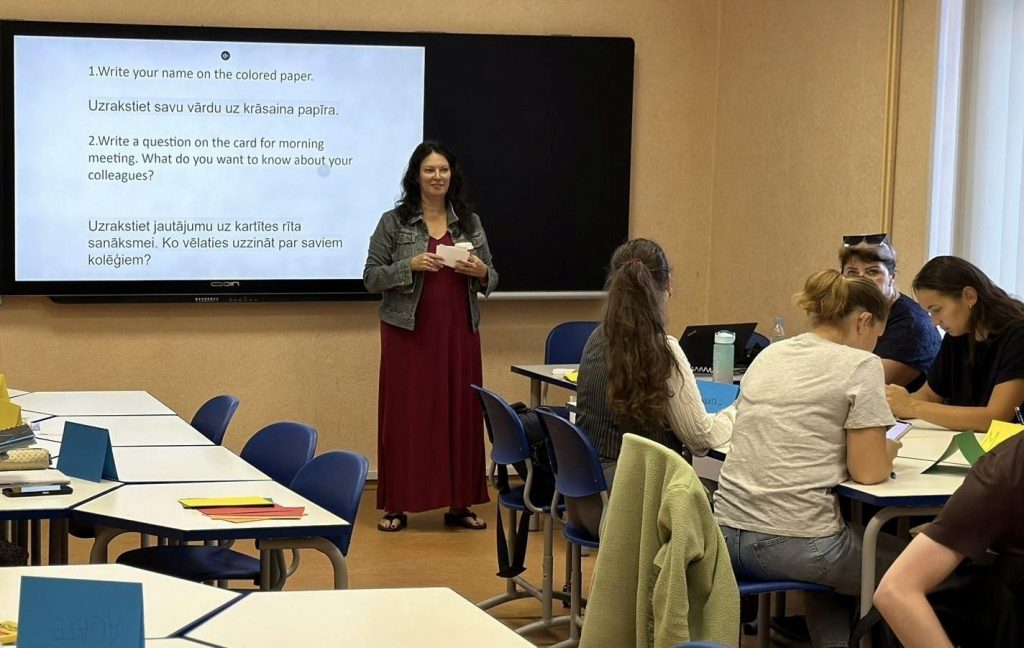
One strategy I used is based on the Morning Meeting approach, which is designed to foster a sense of community within the classroom. Each day began with a student-generated question, which allowed students to practice their English skills through listening and speaking, while also sharing personal stories and perspectives.
My morning meeting has been adapted to utilize student-written questions for their peers. Each class, I randomly chose one student’s question to read aloud; the expectation was that everyone responded, including me. This introduction to the class serves as a warm-up to help students become comfortable speaking in class and, in this case, to practice conversationally in English.
In one of the courses I taught, Latvian was initially the language of instruction; therefore, the English levels varied. Students used English in a low-stakes, conversational context. This approach allowed students to gain confidence and reduce anxiety that often comes with speaking another language. Creating a welcoming space for informal language use, morning meetings fostered a sense of community and helped students become more comfortable expressing themselves in the English language. Morning meetings provided all students with a comfortable entry point, featuring questions such as, “What is your favorite food?” or “Where is your favorite vacation spot?” These simple prompts often led to lively discussions and deeper understanding between classmates. Moreover, this strategy can easily be implemented in their future courses, and students discussed how they could incorporate it into their own classrooms.
Students shaped the conversations and invited multiple cultural perspectives into the classroom. I observed that students became more comfortable speaking English and engaging in conversation with me. This classroom routine was a powerful tool for building trust, fostering community, and promoting intercultural learning —core values that align with the mission of the Fulbright program.
Literature Circles
Literature circles were another instructional strategy I incorporated into two of the teacher education courses. These were designed to enable student autonomy, as students could choose their role in the literature circle and actively participate in determining assigned readings, developing guiding questions, and selecting vocabulary for discussion. Literature circles supported English learners in developing their reading skills, including fluency, comprehension, and vocabulary.
Literature circles were designed for students to work collaboratively in small groups to discuss key points and takeaways. Members of the group took on different roles each week, such as discussion leader, summarizer, illustrator, and real-life connector, and share their perspectives. These perspectives elicited discussions and created purpose in reading.
Central to the course was a book study of Zaretta Hammond’s Culturally Responsive Teaching and the Brain. Although the demographics of race and ethnicity of the United States and Latvia differ, teachers in both countries face similar classroom challenges (e.g., different cultural backgrounds, stereotypes, and language learners). Our discussions, sometimes intense, were always open and honest. I was aware of systemic challenges faced by local teachers including the Latvian language-only policy and the presence of Russian-speaking students in their classrooms, but I did not want to impose my perspective on them. Hammond’s book served as a framework to facilitate these conversations, and over time, teachers began initiating discussions about their own experiences.
This approach confirmed the importance of cultural awareness and respectful dialogue, especially when addressing sensitive or controversial issues. I learned the importance of guiding rather than leading these conversations. Modeling vulnerability and sharing my own professional experiences helped create a space where participants felt safe to engage authentically. These discussions were among the most meaningful of my entire Fulbright experience.
Literature circles were also utilized in the course for students preparing to become elementary and secondary English teachers. Since this was an unexpected class that I was able to teach, I did not bring my novels with me for this particular course. Therefore, my choices were limited, and time was a significant issue compared to what I could order in the United States. I chose a well-known young adult novel, Wonder, by R.J. Palacio, that would go beyond cultural boundaries through its themes. The students actively participated in each class, as observed in their conversations, connections, and questions. They were also highly creative in the illustrator role, as demonstrated by their artistic ability. One student created clay figures based on the characters from the novel.
Using literature circles allowed students to choose roles, lead discussions, and connect texts to their own lives. Literature circles shifted the focus from teacher-led instruction to student-driven dialogue. Additionally, students brought their own experiences and culture into the conversations in ways that, as an outsider, I could not have done. Although an American author wrote the novel, its universal themes (e.g., inclusion, belonging, friendship) transcended cultures and opened space for meaningful dialogue. Students drew parallels between the characters’ struggles and their own realities, such as working with children with disabilities, supporting others in belonging, and the importance of friendship. They were able to find common ground while also highlighting unique cultural perspectives.
Students in the courses that participated in literature circles were able to keep their books. Their reactions were expressions of surprise and joy. They expressed their gratitude and excitement at being able to keep the books as their own. I hope that they instill the love of reading in their future students in Latvia.
Pink Time
Pink Time is another research-based instructional strategy, based on Daniel Pink’s book Drive (not the color), which ascertains that motivation is based on autonomy, mastery, and purpose. Pink Time provides students with time off from class to explore and learn about topics of interest, whether related to the course or not, and thus creating opportunities to increase student motivation. Students return to class and share what they learned with the whole group. After all students have shared, the instructor leads a discussion and facilitates conversations around the importance of self-directed learning, learning outside the classroom, and the importance of effort in learning. They explore how they perceive themselves as learners and develop awareness of their learning process by discussing their learning experiences. By embedding autonomy (choosing a topic), mastery (students wanting to learn and improve) and purpose (connecting their learning to personal reasons and sharing with others), Pink Time incorporates Daniel Pink’s concepts of motivation into classroom practice. Like Genius Hour and Project-Based Learning, Pink Time is student-directed. However, Pink Time includes an instructor-led conversation that explicitly discusses the importance of metacognition, and how students learn about the process of learning. Pink Time also eliminates the external reward of a grade by having students grade themselves.
I conducted Pink Time in both the master’s course and the preschool course. The strategy gave students time to pursue an interest and share it with the class. Students were excited to share what they learned, as demonstrated by their eagerness. Additionally, they were attentive listeners and asked thoughtful questions. Pink Time provided an opportunity for students to discuss how they learned and what they learned about themselves. Additionally, it gave insight into what is important to each of the students.
Field Trips
Field trips allow learners to connect with their surrounding environment and provide students with experiential learning opportunities. Field trips provide students with opportunities to increase their interest and motivation. They allow them to interact with different environments through observation, inquiry, and hands-on learning. I organized a field trip for students majoring in preschool education. The local area features the Nature House, an interactive science house, complete with habitats for ants and cockroaches. There is also a learning boat that takes trips on the lake, where participants can collect water samples and use microscopes to observe lake specimens. Organizing a field trip also pushed me out of my comfort zone at the university and encouraged me to find opportunities for my students to utilize local resources. It also allowed me to work with different community members, including the women at the Nature House.
The students who attended the field trip participated by observing the habitats, using the interactive wind tunnel, asking questions, and having conversations with the tour leader. As they interacted with the exhibits, several students remarked that preschool children exhibit the same sense of curiosity they experienced, which could easily be fostered through field trips and hands-on learning. They began discussing how they might adapt similar activities for younger learners in their own classrooms, such as observing insects or experimenting with air movement.
Using local resources, like the Nature House, helps instill the importance of creating opportunities for hands-on learning outside the classroom. Additionally, drawing on local resources supports sustainability and ensures the continued ability to provide meaningful, community-based learning experiences.
Enduring Impact
As with any new semester, I initially worried about connecting with my students in Latvia. This was a new country and culture for me, and I was sharing the courses with other professors rather than serving as the instructor of record. I also did not speak the native language, though I learned simple conversational phrases that helped build rapport. Fortunately, most Latvians speak English as part of their participation in the European Union, so communication was manageable. During orientation and conversations with colleagues who had lived in the country, I learned that Latvians often consider themselves introverts—less likely to initiate conversations but willing to engage when approached.
Despite these challenges, I drew on my prior experience building a community of learners. I incorporated familiar strategies such as morning meetings, literature circles, Pink Time, and a field trip. These approaches, grounded in motivation and engagement, proved effective across cultural boundaries. They reinforced the idea that supportive, student-centered practices can foster meaningful connections and enhance learning in any setting.
In addition, these practices helped me gain a deeper understanding of both the people and the culture of Latvia. Ultimately, the experience affirmed that intentional, inclusive strategies can transcend differences in language and context, creating a classroom environment where students feel connected and learning thrives.
My Fulbright experience in Latvia has had a lasting impact on both my teaching and my academic work now that I have returned to my institution in the United States. This semester, for literature circles, all students are reading the same novel. This approach proved highly effective in Latvia, where students engaged in small-group discussions and then came together as a whole class to clarify questions and deepen their understanding of the material. Additionally, assigning the same text helps address challenges related to student absences during literature circle time, since students can move fluidly between groups without losing continuity.
Beyond the classroom, I am collaborating with colleagues to explore incorporating field trips into my courses to enrich and expand the student learning experience. This idea grew from observing the impact of experiential learning in Latvia, and it will create more meaningful connections for my students here.
Finally, I am analyzing the data I collected on Pink Time during my time abroad. Although, I am not currently in communication with former students, as I continue this research, I plan to engage in member collaboration with former Latvian students to ensure the accuracy and authenticity of the data. The students themselves expressed eagerness to read the findings, and I look forward to sharing the research with them.
Creating a caring and student-empowered environment surpasses language barriers.
My Fulbright experience has not only broadened my teaching practices but also strengthened my commitment to student-centered learning and collaborative research. The insights gained in Latvia continue to shape the way I approach pedagogy, curriculum design, and scholarly work. Teaching in Latvia deepened my teaching philosophy by underscoring the importance of building relationships and being true to myself. It reminded me that creating a caring and student-empowered environment surpasses language barriers and reaffirms my commitment to fostering culturally inclusive and motivating spaces wherever I teach. While instructional strategies are essential, it is the human connections formed through open dialogue, shared stories, and mutual understanding that truly define a meaningful international exchange, for which the Fulbright is intended.
Conclusion
As educators, we never fully know the impact we have on our students, and often, our students shape our own teaching and learning in even greater ways. My experience in Latvia reinforced this truth, as I learned as much from my students’ perspectives and cultural insights as they did from me. As I continue my teaching practice, I strive to connect in meaningful ways that foster growth for both my students and myself.
Further Reading
- Baird, T. D., David, D. J., Kniola, J., Lewis, A. L., & Fowler, S. B. (2015). Pink time: Evidence of self-regulated learning and motivation among undergraduate students. Journal of Geography, 114(4), 146–157.
- Behrendt, M., & Franklin, T. (2014). A review of research on school field trips and their value in education. International Journal of Environmental & Science Education, 9(3), 235-245.
- Daniels, H. (2023). Literature Circles: Voice and Choice in Book Clubs & Reading Groups, 2nd ed. Routledge.
- Poplawski, K. (2023). Morning Meeting. 4th ed. Center for Responsive Learning.
- Verzemnieks, I. (2017). Among the Living and the Dead: A Tale of Exile and Homecoming. W. W. Norton & Company.
Biography
Caryn M. Caruso, PhD, is an Assistant Professor and Elementary Education Coordinator in the College of Education at Lander University in Greenwood, South Carolina. She was in Latvia at the Riga Technical Institute-Liepaja from August 2024 to January 2025, where she taught in the Department of Education, Culture, and Social Welfare. She can be contacted at ccaruso@lander.edu.