
Fulbright Chronicles, Volume 4, Number 3 (September 2026)
Author
Erika J. Waters
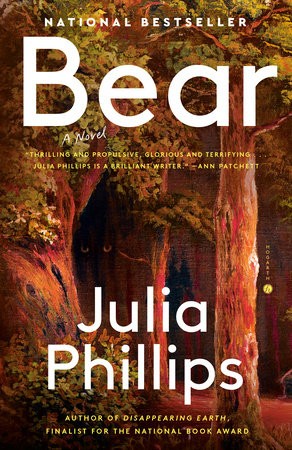
Bear by Julia Phillips, who was a Fulbright Scholar to Russia, 2011-2012.
While bears appeared in early nineteenth-century European fairytales as enchanted, kindly creatures, it was Teddy Roosevelt who shaped the image of bears in the popular imagination when he refused to shoot an injured, caged bear in 1902. Soon, “teddy bears” became a world-wide phenomenon, and bears were viewed not as wild and dangerous but as cuddly and comforting. Anthropomorphic bears soon appeared in children’s books, among them The Roosevelt Bears, Winnie the Pooh, and Paddington Bear and they were featured in national advertising campaigns, such as the US Forest Service’s famous Smokey the Bear.
“This dichotomy—bears as cuddly and comforting vs dangerous and violent—is at the heart of Bear.”
Yet, when Chicago named its football team the “Bears,” and Memphis called its basketball team, the “Grizzlies,” their intention was to evoke a very different image, one of brute force and strength, which is certainly more realistic for anyone who’s ever actually seen a bear up-close, whether in captivity or in the wild. This dichotomy—bears as cuddly and comforting vs dangerous and violent—is at the heart of Bear, a novel by Julia Phillips.
The bear story which most directly influenced Julia Phillips’s novel, however, is the Grimm’s fairy tale, Snow-White and Rose-Red, reprinted at the back of the book. In that story, two very close sisters—so close they always hold hands—live with their widowed mother. They’re saved from an evil dwarf by a bear they had befriended, who it turns out had been bewitched by the dwarf and was, in fact, a wealthy prince.
Similarly, in Bear, there are two, dutiful sisters; in this case, they both have dead-end, low-paying jobs. Home is a “stale” ranch house in the San Juan Islands, once-owned by their grandmother, and they’re caregivers to their dying mother, a victim of the toxic chemicals she inhaled as a nail technician.
The sisters are very close—at least they are from younger sister Sam’s perspective—and that bond is vital to her existence: “For years, in the midst of the mindless buzz produced by every other person on this island, Sam had believed she had one good, real thing: her sister” (232). She’s convinced they share the same dreams of an escape from the islands that so restrict and imprison them. This turns out, though, to be an illusion, shattered when a huge brown bear makes an unlikely appearance.
Elena sees no danger at all and talks about the bear, “the way a person might if an angel touched down in front of them” (36). According to her, “the bear was their one good thing: a specter, a spirit, an extraordinary beast. A visitor from someplace enchanted. A visitor from the mysterious world. . .teaching them what is was to love living, helping them to make it through” (120). The bear is “furred and muscle-bound” (151) and exudes a raw, male power; she’s clearly attracted to her “bear-lover” (180). Elena is sure the bear is kind, loving, protective, and insists there is no risk. Despite warnings, she entices the bear with food.
For her part, Sam is horrified and recognizes the danger. The bear is “bigger than a refrigerator” and stinks of “old urine, wet dog” (152). She alternately seeks and rejects the pragmatic advice of a woman from the state Fish and Wildlife Authority and is equally ambivalent when an old high school classmate, a neighbor, offers assistance. She also suspects the motives of her fellow ferry worker/lover who seems to genuinely care about her. In fact, Sam rejects everybody who tries to help her hapless family and trusts no one. All of this leads to the inevitable tragic ending, which while predictable, is nonetheless dramatic and shocking, even heart-breaking.
All of this transpires in the beautiful San Juan islands, an interesting choice for Phillips. Bear sightings are rare there, but the islands offer a metaphor for the family’s narrow, contained world where there’s no easy escape. Even more to the point, Sam works the concession stand on the ferry; her life plays out in a constantly repeating circle. The ferry moves from island to island, transporting tourists from all over the world, yet she herself never actually goes anywhere. A boat might be a symbol of escape, but in this case, it’s static, like a rocking horse, constantly moving but going nowhere.
Although the sisters lead boring, mundane lives—enlivened only by the bear’s presence—their story is compelling and suspenseful. Even if you suspect the story can’t end well, you’re still propelled forward. You’ll be fascinated by the hold this enormous, wild beast has on Elena, how she fools herself through desperation and isolation—and obsession. Maybe most of all, you’ll be intrigued by the complicated bonds of sisterhood and familial obligations which Phillips so deftly explores.
Julia Phillips, Bear. New York: Hogarth, 2024. 302 pages, $12.00.
Biography

Erika J. Waters was a Fulbright Scholar to Turku, Finland in 2005. She is Professor Emeritus from the University of the Virgin Islands and founding editor of the literary magazine, The Caribbean Writer. She also edited collections of poetry, fiction, literary criticism, and drama and received grants to study women writers from the National Endowment for the Humanities and the Tulsa Center for the Study of Women’s Literature. Later, she taught at the University of Southern Maine and wrote books on Maine, the Virgin Islands, and vintage Florida. She’s published articles and interviews in magazines and websites, including Ms. Magazine, World Literature Today, and The Chronicle of Higher Education and co-hosted a podcast called Cool Dead Women. She is currently the Book Review Editor of Fulbright Chronicles.