
Fulbright Chronicles, Volume 4, Number 3 (September 2026)
Author
Swayam Sampurna Panigrahi
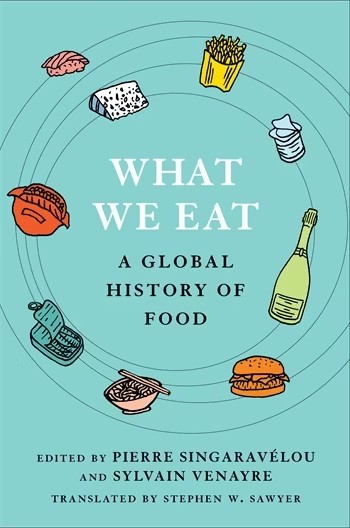
What We Eat, A Global History of Food, ed by Pierre Singaravélou and Sylvain Venayre. Translated by Stephen W. Sawyer who was a Fulbright Scholar in Paris from 2000-2001.
Food is more than merely nourishment, and What We Eat: A Global History of Food makes that point powerfully. Spanning continents and centuries, this compilation of essays by noted historians explains how everyday foods carry stories of empire, resistance, labor, technology, and social change.
One of the book’s early strengths, for example, is its framing of food alongside political resistance. By placing the Boston Tea Party and Gandhi’s Salt March within the same opening narrative, the editors remind us that food has long been a medium for protest and sovereignty. They go on to explain that as the world industrialized, food underwent a significant transformation as well. Food production triggered a packaging revolution, reshaping not only how food was stored and transported, but also how it was marketed and perceived. Food was often promoted as “healthy” without thorough scientific verification, and such misleading health claims continue to exist even in modern food marketing.
The global mobility of food is a recurring theme in food history, as the movement of ingredients, practices, and culinary terms has long predated modern globalization. Food has always travelled, and its linguistic traces often reveal these journeys. For instance, words such as “sugar” and “pepper” can be traced back to Sanskrit, reflecting early trade and cultural exchange, according to author Julie Marquet. Similarly, the evolution of dishes like curry illustrates how culinary practices adapt and transform across regions. Its regional parallel, tarkari, a staple in Odia cuisine, has been part of ritual offerings to Lord Jagannath at the Puri Jagannath Temple since the twelfth century.
“What We Eat beautifully highlights specific foods to explain broader social and economic dynamics.”
What We Eat beautifully highlights specific foods to explain broader social and economic dynamics. Pauline Peretz makes the point that bagels, for instance, are not merely baked goods, but symbols of protection due to their circular shape. While discussing baguettes, Christian Grataloup notes that one theory attributes their shape to Napoleon I: an elongated shape “made it easy to carry in soldier’s basques or trousers” (16). While the historical accuracy is unknown, it illustrates how food forms can be shaped by practical considerations like portability and convenience during wartime.
Interestingly, the rise of fast food has been associated with shortened lunch breaks, illustrating how certain food innovations can restructure daily routines and, at times, constrain individual autonomy. However, not all food practices function in the same way. Traditional formats such as dim sum, originally consumed as a leisurely tea accompaniment, reflect a contrasting culture of slow, social dining. This practice has been documented in establishments such as the Pearl Pavilion (dating to 1745) and the Guangzhou Tea House Association, as well as in the renowned Glorious China tea house (founded in 1876), according to Françoise Sabban. Similarly, other food forms illustrate how culinary practices adapt to shifting socio-economic contexts. The rise of the Turkish döner kebab in Germany reflects patterns of migration and urban labor markets, as Özge Samanci, points out. The growing use of freeze-dried food has been linked to increased female workforce participation and the demand for convenience, according to Martin Bruegel.
Caviar’s spread, for instance, guided by the migration of sturgeon fish, illustrates how rarity enhances value even when the product itself remains unchanged. Stephanie Le Bras explains how champagne’s identity as an aristocratic beverage has been embedded into consumption practices.
Pascal Ory writes about the particularly compelling history of coffee ; its growing demand in Europe was historically linked to systems of slavery and exploitation elsewhere. The emergence of substitutes, such as chicory, illustrates how food systems adapt under conditions of scarcity and political control. During Napoleon’s Continental Blockade, for example, coffee imports to Europe were severely restricted, prompting Napoleon to encourage the use of roasted chicory root as an alternative. Over time, this substitute became widely accepted in Europe, to the extent that the French language adopted the German term “ersatz” to describe such replacements.
Equally striking is the discussion of condensed milk, which was initially marketed as a substitute for breastfeeding and later promoted as supporting women- despite the fact it deprived children of adequate nutrition. Canadian historian Laurence Monnais points out that companies like Nestlé positioned their product in Asian women’s magazines as “an indispensable aid in infant growth,” (82) masking commercial interests as maternal welfare.
Ultimately, What We Eat succeeds because it treats food as a living archive of human history. It is about emotion, power, identity and ethics, and it reminds us that every bite we eat carries scrumptious stories. For Fulbright alumni and globally minded readers, this book offers not just knowledge, but a deeper awareness of how interconnected our plates truly are.
Singaravélou, Pierre and Sylvain Venayre, eds. What We Eat, A Global History of Food. Translated by Stephen W. Sawyer. New York: Columbia University Press, 2025. 360 pp. $26.00
Biography

Swayam Sampurna Panigrahi, is a Fulbright-Nehru Postdoctoral Fellow at the Gladstein Family Human Rights Institute, University of Connecticut, researching human rights issues in the textile and apparel supply chains. She is an Assistant Professor at IFMR GSB, Krea University, India, and earned her Ph.D. in Business Management from XIM University. She has received two Emerald Literati Awards for her research contributions. She brings interdisciplinary expertise combining engineering, policy, and commitment to ethical business practices. Her academic travels have cultivated a deep appreciation for diverse culinary traditions, allowing her to explore the rich food histories of the countries she visits. She can be reached at spm25002@uconn.edu.