
Fulbright Chronicles, Volume 4, Number 3 (September 2026)
Authors
Nelly M. Robles Garcia and Jack Corbett


Abstract
Many ex-Fulbrighters interested in maintaining engagement abroad overlook opportunities such as the Alumni engagement Innovation Fund, supporting applied projects encouraging cross-national collaboration. A binational team worked with a multicultural mix of small communities in Mexico’s Cuicatlán Valley toward developing a framework.
for cooperation by staging a cultural fair. The fair shared knowledge, contributed to an awareness of common interests, and promoted interaction with outside supporters, thereby nurturing the Ruta del Río Grande.
Keywords
collaboration • community • Cuicatlán Valley • cultural fair • innovation
Introduction
Presumably most readers are familiar with traditional Fulbright Scholar Awards, i.e., those supporting study/teaching/research abroad or, for non-Americans, in the United States. And many will recognize awards targeted to specific activities or publics, such as Fulbright Specialist Awards, Fulbright Arctic Initiative, or Fulbright-Fogarty Awards in Public Health. Beyond these lie awards open only to alumni of the multiple programs of the State Department’s Bureau of Educational and Cultural Affairs (ECA), including ex-Fulbrighters. Less well known, the Citizen Diplomacy Action Fund (CDAF) and the Alumni Engagement Innovation Fund (AEIF) are competitive awards open to teams of two or more ECA alumni focusing on a specific topic or initiative designed to enhance community capacity, support organizational problem-solving, or extend the impact of a Fulbright or other ECA-sponsored experience. They encourage engagement in an applied fashion, fostering multiple forms of collaboration. Here we discuss how one such effort drew upon Fulbright experience to propose, develop, shepherd, and ultimately expand an AEIF project.
Context
In 2018, twenty years after Mexico established the Tehuacán-Cuicatlán Biosphere Reserve, UNESCO declared it a World Heritage Site. Spanning approximately 490,000 semi-arid hectares along the Puebla-Oaxaca border, the reserve was recognized not only for its biological diversity but also for human achievements in domesticating food plants, managing scarce water resources, and establishing complex cultural systems under demanding conditions. Despite these accomplishments, the scattered communities supporting much of the regional population lived a near-subsistence existence, with marginality and out-migration as continuing challenges. Fragmented by linguistic and cultural differences and with limited support from state and national governments, these communities had few opportunities to identify or pursue initiatives to improve their circumstances. The World Heritage designation by itself proved insufficient to mobilize resources or encourage innovation.
Nevertheless, scattered efforts suggested developmental potential. The National Commission for Natural Protected Areas (CONANP), charged with managing the Biosphere Reserve, occasionally worked with some communities on specific projects, and the National Institute of Anthropology and History (INAH) undertook limited attempts to address archaeological remains. The Foundation for the Cuicatlán Biosphere Reserve, a small foundation in the Cuicatlán Valley, also created modest initiatives. Unfortunately, a lack of resources and coordination thwarted any serious regional impact. Only in 2021 did a small grant from American Express finance a preliminary assessment of possible collaboration for the creation of the Ruta del Río Grande, an ecotourism proposal linking communities along the Río Grande, the principal watercourse in the valley.
Enter the AEIF
In early 2024, a binational team of ex-Fulbrighters submitted a proposal to that year’s AEIF competition (besides the authors, the team included Anabel Lopez Salinas, International Funders for Indigenous Peoples; Verónica Pérez Rodríguez, SUNY-Albany; and Marcia Medrano Serrano, Instituto Nacional de Bellas Artes y Literatura). The proposal sought to address the challenge of cross-community collaboration by bringing the communities together around a joint project. While the seven prospective participants in the Ruta del Río Grande did not have antagonistic relationships, their insular natures meant there was little history of cooperation—at best a superficial awareness. Some identified as Mixtec or Cuicatec, one was traditionally Mazatec, and another was an Afro-mestizo community descended from slaves imported to work a colonial sugar plantation. Some communities were best known for craft or gastronomic traditions, others for biological or archaeological resources. No single community could attract many visitors based on its specific assets but taken together they could offer a rich experience in a region little known to outsiders. How to encourage such innovation?
After some thought and discussion with residents, the team proposed staging a regional cultural fair. One advantage would be drawing on known resources, such as recognized archaeological resources in three communities or crafts in others. A second advantage was that it was specific and finite; it would take place in a given location at a defined moment, with clear tasks, expectations, and outcomes. And third, it would enable people to learn about each other, establishing some basis for interaction and a broader awareness. This was particularly important because one purpose of the fair was to promote linkages among communities, not with team members. Thus, from the beginning there needed to be a sense of joint purpose and commonality, a perspective more easily articulated than cultivated. While promoting a fair received broad support, making it happen required a major investment of energy and continuing adaptation. This became more pressing with notification in spring 2024 that the proposal had been accepted.
Creating a Framework
The first critical matter was creating a viable organizational framework to do the basic lifting. Cuicatlán villages have internal committees for managing their resources, so it made sense to turn to them to select their respective cultural fair committees. Yet communities have very specific processes for committee selection, and individuals selected were not necessarily people prepared for or interested in serving on such a body. In two cases, no local committee ever materialized, but fortunately ad hoc substitutes stepped forward out of personal interest. In some cases, the resource committees themselves assumed the role. Some fair committees understood their tasks, while others did not or sidestepped them.
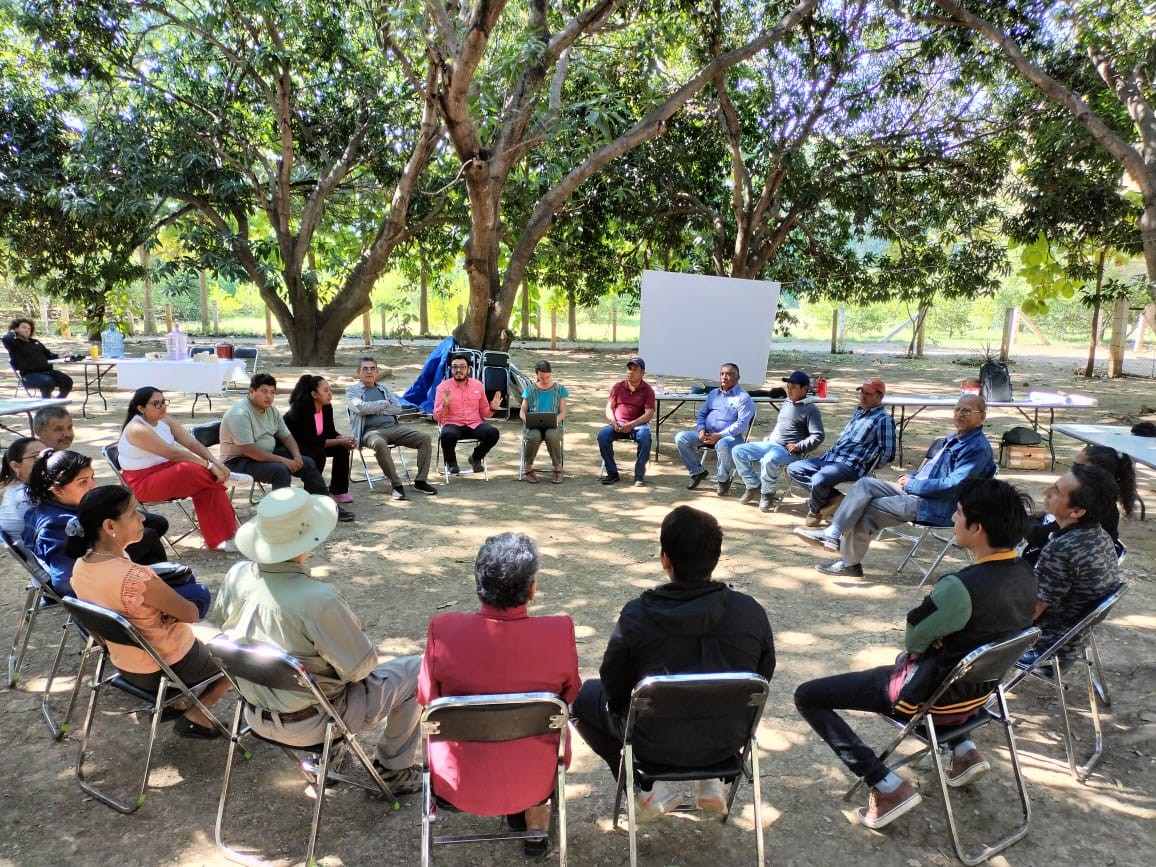
A second key step was to organize a series of training workshops around the broader topic of the Ruta del Río Grande, linking the purposes of the fair with the more general concept. At first each committee sat together, but deliberate mixing, though received warily, gradually led to more open and informal exchange. As committee members recognized commonalities or distinctive features, discussion flowed more smoothly, with participants interacting with each other instead of with the AEIF team. In contrast, attempts to form advisory committees of state and federal officials went nowhere. The intent was to help link communities with agencies at higher levels, but their personnel were either busy or uninterested. With the federal government channeling its funding to major infrastructure projects, and the Oaxaca state government following the federal lead, there was little incentive to attend to a minor project from a low-priority region.
By fall 2024, the cultural fair had begun to take shape. The date would tentatively be July 5, 2025, in Cuicatlán, the largest of the valley communities. Early indications suggested twelve to fifteen exhibitors, roughly half from the communities, the rest from CONANP, INAH, and a few other organizations. Local committees encouraged participation, addressed logistics, and joined occasional training sessions. Plans moved forward slowly but steadily.
Then disaster struck. At the end of January 2025, the U.S. Embassy notified the AEIF team that all financial support had been frozen by the incoming administration, with no indication of when or if it would be released. Community reactions ranged from distressed to a sense of betrayal. As weeks dragged by, village committees began to lose hope, seeing this as one more case of outsiders making promises, then walking away. It was difficult to explain why a government seeking to reduce migration would torpedo a project that could help accomplish it. Suddenly, in mid-April, the funds reappeared, but the fair had lost momentum and there was no way to hold a July event. After much consultation, it was rescheduled for September 6, in the desperate hope that the time and energy invested could be recovered.
Breakthroughs
But luck had changed. First, committees collaborated on a video addressing the Ruta del Río Grande and dimensions of community life. Successful completion would include a world premiere at the fair. Second, the Oaxaca state Secretary of Culture became interested in the project. Ultimately, he provided access to state facilities, a series of arts workshops, and a contingent of state police to ensure public safety. He also provided pre-fair publicity on the state television channel and statewide broadcast of the video on September 7. Third, the delay increased regional discussion regarding the fair and its potential significance. Opportunities to engage other publics emerged, from non-Ruta communities, educational institutions, nonprofit organizations, and even media from Mexico City. In the process, the cultural fair transmuted from a modest community effort to an expression of regional aspirations.
The substantial, unexpected expansion of interest in the fair put considerable strain on the time and energy of the AEIF team and a number of local volunteers, and at midnight on September 5 they were still putting final arrangements in place. But the fair went off without a hitch except for a rather substantial traffic jam in the immediate vicinity. Vendors arrived from fifty miles away, carloads of curious visitors made the two-hour drive from the city of Oaxaca, and the U.S. Embassy, underscoring its AEIF seed money, sent a delegation and presided over the video premiere. The twelve to fifteen exhibitors originally anticipated mushroomed to forty-five officially registered, plus a fluctuating number of food vendors who simply occupied spaces on the periphery. Craft producers and organization representatives shared experiences and invitations. The video impressed the audience, with Minister Counselor Silvio I. Gonzalez of the Embassy distributing copies to all the communities, and the film’s director announcing that it would be entered in several international festivals.
Ripple Effects
Community committee members expressed surprise, satisfaction, and occasionally awe at what they had accomplished. And in fact, they accomplished more than these numbers suggest, as the buzz of activity in the months prior to the fair encouraged others to take positive steps. Rotary Clubs from Mexico City initiated water retention and irrigation projects in several communities. The Banamex Cultural Foundation conducted an assessment of possible artisanry workshops in various communities. The Mellon Foundation financed a visitor center for an important cave painting site in the community of Dominguillo, while INAH announced funding of archaeological restoration in Quiotepec. And other possibilities are under consideration, including a community museum in Jaltepetongo. In 2024, the cultural fair was seen as a stand-alone project. Now people refer to the Ruta del Río Grande Initiative, reflecting a sense that these and other efforts should be understood as a coordinated vision for the Cuicatlán Valley.
What Did We Learn?
Just as scholarly Fulbrights anticipate periods of reflection after a period abroad, so too do AEIF and CDAF awards. Careful planning and performance expectations confront unanticipated circumstances, and a team’s adaptive capacity may be tested outside the boundaries of proposal design. Although the AEIF team totaled more than one hundred years of field experience in rural communities, we still encountered complex challenges. While we brought different professional backgrounds to the project, the commonality of Fulbright participation, i.e., an appreciation of the centrality of addressing personal relationships, gave us a bond and pathway for moving forward. This awareness is crucial for citizen vis-à-vis institutional diplomacy.
First, allow for human complexity. Assumptions regarding the uniformity of social categories, e.g., Indigenous communities or levels of education, can lead to a flattening of descriptions concealing critical variations, in effect producing stereotypes obscuring much more than they reveal. Even small villages may include contending factions, strong leaders, shifting coalitions, pervasive apathy, self-interested cliques, and external alliances. Much of our time was devoted to sorting through, courting, neutralizing, and otherwise managing relationships with subpopulations bringing to the project concerns secondary to us but central to them.
“They want allies making investments in them, not vice versa. When direct participation counts, there are no substitutes for sweat equity and blisters.”
Second, explanation and exhortation are insufficient. Groups and communities often have been bombarded by outsiders telling them what to do; they want allies making investments in them, not vice versa. When direct participation counts, there are no substitutes for sweat equity and blisters. What kind of investment are you willing to make to gain legitimacy for your position?
Third, look for allies. The AEIF project was well-framed and promised local payoffs. Nevertheless, its success was far from certain without collaboration from allies lacking formal credentials but well versed in community dynamics. They may possess local knowledge, clarify ambiguities, assess options, provide access and warnings, and otherwise smooth the way. Some allies may be predictable; others appear suddenly or must be corralled.
Fourth, be careful of allies. Conversely, allies may be allies but with their own agendas. Indeed, a willingness to serve as an ally may have less to do with their engagement with your proposal and more to do with your potential value for their agenda. We found one ally was willing to support us precisely because we could serve as a resource for someone that ally was courting in turn. An uncritical search for allies might produce a counterproductive alliance.
Fifth, weigh potential multiplier effects. Attempting to mount a viable, coherent project is a challenge in itself without flights of fancy or wandering by chance into additional commitments. Nevertheless, it pays to be attentive to ways in which a project with one focus leads to potential further opportunities. Most of those mentioned under Ripple Effects have at some point called, or will call, on this AEIF team for advice and assistance. What can we reasonably do?
Sixth, beware of time commitments. Project participation offers a solid alternative to longer, more extensive projects pursued under a traditional Fulbright application. Again, definition and design presumably impose constraints. Yet the complexity and institutional considerations bounding full-scale Fulbrights are less evident in projects, making it easier to stray into arenas that consume time without yielding the returns hoped for under the cover of a Fulbright award.
Seventh, always have a Plan B. Recognize that projects rarely have smooth sailing, and it is common to confront an unexpected dilemma; the cultural fair confronted three.
One was the suspension of funds and associated uncertainty. Cancellation might have ended the Ruta del Río Grande, but drift was almost as bad. Patchwork held the project together at the cost of great stress. Another was the overt disappearance of two fair committees. Networks cultivated in anticipation of the situation created acceptable ad hoc workarounds. A third was the difficulty outside collaborators had in understanding communities banding together for voluntary action and unpaid service. They repeatedly complained that the locals were “investing nothing,” failing to recognize the enormous contribution such participation provided. This required constant reminders of the long-term benefits of collective effort for regional integration.
The emerging initiative requires far more effort, resources, and commitment than envisioned, but the Ruta del Río Grande is alive and moving forward. A regional visitor facility and a fair celebrating the valley’s heritage and potential as a fruit-production center are currently on our future projects list. And it all started with an AEIF award.
Further Reading
- Bolaño de la Lanza, Alexanderson, dir. “La Ruta del Río Grande: El Documental.” Oaxaca, September 2025. Video, 26 min., 40 sec. Subtitled in English. https://www.youtube.com/@larutadelriogrande.
- Corbett, Jack. “Beyond the Cueva de las Manitas: Organizational Dimensions of La Cañada Initiative.” Paper presented at the Society for American Archaeology Annual Meeting, Denver, April 2025.
- Corbett, Jack, and Nelly M. Robles García. “Overloaded or Indifferent? Site Management at the Tehuacán-Cuicatlán Valley.” In World Heritage Watch 2025, edited by Stephan Dompke, 102–5. World Heritage Watch, 2025.
- Robles García, Nelly M. “Valle de Tehuacán-Cuicatlán: Integración a la Agenda 2030 o el camino hacia la sustentabilidad.” In 50 Años de la Convención Mundial en México e Iberoamérica, edited by Francisco Javier López Morales and Nelly M. Robles García, 451–59. Municipio de Querétaro, 2022.
- Yetman, David, and Alberto Búrquez. Mexico’s Valleys of Cuicatlán and Tehuacán: From Deserts to Clouds. University of Arizona Press, 2023.
Biography
Nelly M. Robles García is a senior archaeologist with Mexico’s National Institute of Anthropology and History. She held Fulbrights at the University of Georgia (1991–1994), Harvard University (2013–2014), and the University of Texas (2023). In addition to a stint as National Coordinator of Archaeology, Nelly, author or editor of more than fifteen books on archaeology, has served on multiple international commissions and as a UNESCO trainer. Her email is nellym_robles@yahoo.com.mx.
Jack Corbett is on the faculty of Portland State University, Portland, Oregon. He has been a Fulbright awardee in Mexico (1969–1970, 1995–1996), Canada (2005), and Canada/Mexico (2015–2016). His work in international education has facilitated the cross-border movement of more than one thousand students, producing more than a dozen Fulbrights. His email is oaxport@gmail.com.