
Fulbright Chronicles, Volume 4, Number 3 (September 2026)
Author
Jenny Dorsey

Abstract
During my 2023–2024 Fulbright-National Geographic Fellowship in Singapore, I investigated how UNESCO heritage designation intersects with economic sustainability in hawker centres (government
-run prepared-food markets). While existing policies appeared to prioritize the preservation of hawker centres’ form, hawkers desired the preservation of their function and utility. Through 21 interviews with a diverse set of hawker vendors, my research revealed how gaps between policy intentions and implementation shape hawkers’ sense of self-worth and professional identity.
Keywords
hawker centers • food studies • food policy • Singapore • UNESCO intangible heritage
Introduction
Singapore’s hawker centers arose as a practical solution to public health needs. Throughout the 1960s, itinerant street food vendors operated across the island, serving affordable meals to working-class residents but also raising concerns about hygiene and traffic congestion. Starting in the 1920s, the colonial government began constructing temporary shelters to house these vendors; after independence in 1965, the new Singaporean government invested heavily in permanent hawker centers. The last roving street vendors were resettled by the end of the 1980s.
Today, over 100 hawker centers operate across Singapore, each housing anywhere from 20 to over 100 individual stalls. Hawkers offer diverse cuisines reflecting Singapore’s multicultural makeup; these typically feature Chinese, Malay, and Indian dishes such as bak chor mee (pork noodles), nasi lemak (coconut rice with chicken), and roti prata (a type of flatbread), although newer entrants have pushed into more global offerings such as Korean, Japanese, Turkish, Thai, and Vietnamese. Critically, hawker centers function as more than dining venues; they are vital community third spaces where people gather without obligation to purchase, and locals can converge across social and economic lines.
From their inception, hawker centers have balanced two distinct purposes: form and function. Their form includes the physical characteristics that define these spaces, such as open-air without air conditioning, communal seating arrangements, compact stalls, and affordable price points. The function encompasses their social roles: providing accessible meals for all income levels, offering entrepreneurship pathways for everyday Singaporeans, and serving as community gathering spaces.
In recent years, this balance has grown increasingly precarious. Hawkers (vendors working in hawker centres) face rising costs for ingredients, utilities, and labor, while meal prices have remained relatively stagnant. The median age of hawkers has reached 59, and despite government training programs, insufficient numbers of new entrants are joining the trade. The central tension hawkers navigate is whether their work can remain economically viable while maintaining affordability, which defines hawker culture.
“What does it mean when official policies appear to sustain hawker culture’s form while its functions—and the people who make them possible—face mounting sustainability challenges?”
In 2020, the United Nations Educational, Scientific and Cultural Organization (UNESCO) designated Singapore’s hawker culture as Intangible Cultural Heritage, intensifying these tensions. The designation celebrated hawker centres as expressions of multicultural community life, recognizing how hawking has provided livelihoods for generations and how these spaces embody Singapore’s social fabric. This international recognition brought pride to many hawkers, yet it also made existing contradictions more visible. If hawker culture is an essential heritage worth preserving, why do its practitioners struggle to survive economically? What does it mean when official policies appear to sustain hawker culture’s formwhile its functions – and the people who make them possible – face mounting sustainability challenges?
Arriving at the Question
Existing research on Singapore’s hawker centers has thoroughly examined the transition from street hawking to permanent centers, the role of hawkers in Singapore’s nation-building narrative, and their function as symbols of multiculturalism and social cohesion. Food studies scholars have analyzed hawker cuisine as expressions of ethnic identity and cultural preservation, while urban planning literature has explored hawker centers as examples of successful informal sector integration into formal city planning. Tourism and heritage studies have increasingly studied hawker centers as sites of cultural commodification and place-making, particularly following the 2020 UNESCO designation. Yet, despite this scholarly attention, hawkers’ own perspectives on the policies that affect their daily lives and the long-term sustainability of their trade remain largely absent from the academic literature.
As I spent more time in these centers, persistent tensions emerged in both formal interviews and informal conversations with hawkers. More so than any celebration of international recognition, concerns about sustainability dominated these exchanges: aging operators with few successors, rising operational and labor costs affecting hawkers’ ability to maintain food standards, price controls and other official mandates squeezing profits. A central tension emerged: these spaces are celebrated as essential cultural heritage while simultaneously facing fundamental sustainability challenges. What does preservation of hawker culture mean when the hawkers themselves struggle to survive?
To investigate these tensions systematically, I turned to the hawkers themselves. Policy documents and official narratives could describe the framework of preservation, but only those living and working within it could determine whether it was serving them. Structured interviews became the essential tool for understanding whether what I was observing anecdotally reflected a broader, more consistent pattern across the hawker landscape. Drawing on my background in community-engaged research developed through years of organizing with food workers, I wanted my research process to reflect a core conviction: that sound policy requires listening to those it affects and treating them as experts on their own experiences.
Listening to Hawkers
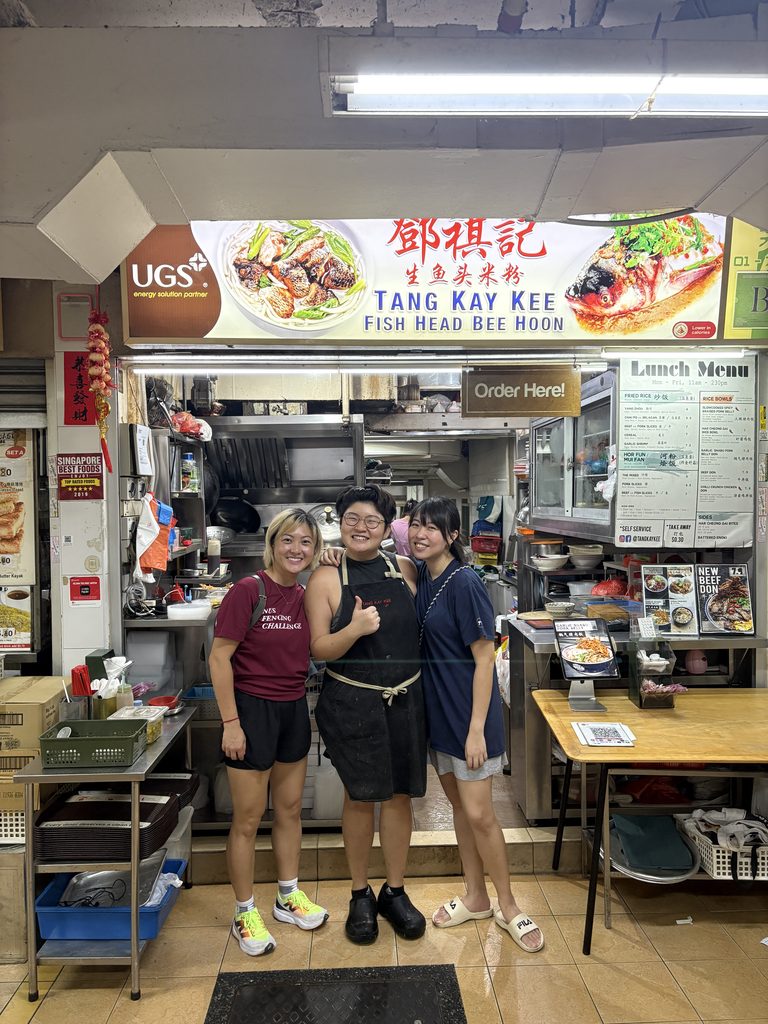
Over nine months between 2023 and 2024, I conducted 22 in-depth, semi-structured interviews with hawkers across Singapore. I employed snowball sampling – a method of recruiting participants through personal referrals – given the tight-knit nature of the hawker community and the need to build trust when discussing sensitive policy topics. Fortunately, the resulting participant pool still reflected considerable diversity across the hawker landscape despite the method’s common drawback of sample bias. I spoke with hawkers operating a variety of stalls, from multi-generational businesses featuring traditional Chinese, Malay, and Indian dishes to popular new entrants offering grilled steak and shio pan (a Japanese salt bun). They ranged in age and experience, from young “hawkerpreneurs” in their twenties to veteran operators in their sixties, and operated across different types of hawker centers, from those managed by the National Environment Agency (NEA) to newer privately-operated ones (Socially Conscious Enterprise Hawker Centers or SEHCs).
This methodological approach returned much more than the (already substantive) findings about costs, regulations, and policy gaps. I learned how much impact seemingly small relational moments can have on how hawkers understand themselves and their work. In one instance, an interviewee described requesting some needed storage space from a government official, only to be rudely dismissed: “Do you want me to open a restaurant for you?” This response was not only unhelpful but implied that the request for basic operational support from the state was unreasonable and that hawkers should be grateful for what they had. The vendor recounted this interaction months later, the sting still evident. It showed me that policy gaps aren’t just a matter of logistics but of dignity. Between the lines of rules and regulations lie moments when hawkers feel their work devalued and their struggles minimized by the very institutions meant to support and celebrate them.
Rethinking Policy Design
My research revealed that even well-intentioned policies can contradict one another, undermining both the form of hawker centers they aim to preserve and the functions of the culture they claim to support.
Consider the original intention of the hawker trade: offering accessible entrepreneurship for ordinary Singaporeans. Today, however, government-controlled rental structures actively exclude newcomers and squeeze existing hawkers. While certain multi-generational hawkers are privy to extremely subsidized rent in the low hundreds, new entrants face market rates of $2,000–5,000+ for comparable stalls – sometimes in the same center. One hawker interviewed recounted that monthly rental bids rose from $800 in 2023 to $2,000–3,000 by 2025, while the Straits Times reported an August 2024 bid of $10,000. When asked if their business would remain viable at current market rates, one multi-generational hawker simply answered, “No.”
Another core aspect of hawker culture is affordability for the masses. While there are no official mandates on pricing at older, NEA-managed hawker centers, newer SEHCs impose a mandatory $3.50 budget meal on all vendors. However, these price mandates do not come with corresponding cost support. Hawkers I interviewed recounted ingredient costs climbing steeply over the past decade: eggs increasing by 66% for a fried carrot cake vendor, and pig intestines doubling for a pig-organ soup seller. Utility bills also surged, with water costs rising dramatically for vendors whose dishes or drinks require substantial amounts of water. As a result, many hawkers reported losing money on every budget meal but being forced to continue selling them to retain their stalls. In effect, this policy maintains an artificially low price for hawker food at the expense of hawkers’ livelihoods.
Long-standing labor restrictions present similar contradictions. Official regulations limit stall operations to citizens and permanent residents, with strict owner-presence requirements, to preserve the “local identity of hawker centers.” However, the National Environment Agency has reported that the median age of hawkers has risen to 59, with many retiring or exiting the trade. A key driver of this is the lack of manpower. Many hawkers I interviewed recounted difficulties hiring local Singaporeans and expressed a need to hire workers from other nationalities to sustain operations. In lieu of such a policy change, however, the government has tried a slew of other programs, such as the Hawkers Succession Scheme (to help retiring hawkers find successors), the Hawkers Development Programme (to prepare new hawkers to join the trade), and the Hawkers Productivity Grant (that subsidizes technological upgrades to lessen operational burdens). Unfortunately, these programs have consistently failed to produce a steady stream of new hawkers willing to enter and remain in the trade or to significantly lighten the operational load on existing hawkers. All the while, more hawker centers are being built, increasing competition for already-struggling operators.
These contradictions stem from fundamental ambiguity: policymakers have yet to clearly define the “hawker culture” they aim to preserve. As a result, policies oscillate between these goals without acknowledging that they often conflict. Simply put, heritage alone doesn’t pay the bills.
Lessons For the Future of Hawkers, from Hawkers
This research fundamentally shaped how I think about knowledge production and whose voices matter in research. What I understood going into this project versus what emerged from listening to hawkers proved remarkably different. While current setups bring in hawkers as consultants, they do not have decision-making power or veto ability. As a result, problems that could have been preemptively addressed or avoided persist due to a lack of operationally experienced stakeholders. For example, in the case of the unsuccessful Hawkers Succession Scheme, which provided a nominal stipend for retiring hawkers to train new recruits, but no money for their decades of culinary knowledge, one hawker questioned: “You want to let a hawker who build [sic] up the recipe, the branding for 30 and 40 years and for nothing, they give it to you? That doesn’t make sense.”
For my final research findings, I focus on the hawkers’ own recommendations. For example, multiple hawkers had clear ideas about infrastructure updates, such as expanding stall sizes to accommodate larger kitchen equipment, reducing physical strain during grueling 12-plus-hour shifts, and adding storage capacity to enable bulk purchasing for volume discounts. Renovating hawker centers to include air conditioning was also repeatedly mentioned, as hawkers currently work in such extreme heat that one interviewee likened cooking while wearing the mandatory face mask to “waterboarding.” However, so far, officials have remained firm in their opposition, citing concerns about altering the traditional open-air character of hawker centers.
Hawkers also showcased a range of creative suggestions for adapting hawker centers to the modern era to attract new vendors and customers alike. One proposed a flexible entry model, such as stall-sharing arrangements in which existing operators could “rent out their shops for dinner” to let curious newcomers “try out the platform and see if it’s viable,” or allowing part-time operations for those with other jobs to cook on evenings and weekends. Another suggestion was to transform underutilized parts of the hawker center into evening food streets, maximizing stall usage during different time periods. As one hawker noted, the centers are “natural event spaces, but you can’t hold an event here…unless it’s a government event.” Relaxing such restrictions could enable regular programming such as hawker showcases, cooking demonstrations, and cultural festivals that position hawkers as skilled artisans and successful business owners.
All these recommendations share a common thread: they emerge from the practical wisdom of hawkers who have on-the-ground experience of what policies implicitly (and sometimes explicitly) encourage or discourage. Rather than prescriptive solutions imposed from outside, they represent practitioners’ sophisticated understanding of how best to adapt for long-term sustainability while maintaining what matters about hawker culture: the function of providing accessible entrepreneurship, affordable meals, and spaces for community gathering.
Fulbright’s Lasting Impact
My time in Singapore has had lasting implications for how I approach my future food research. Before this fellowship, I followed what I had long been taught: to enter the field with hypotheses already formed, shaped by existing literature and my own positionality as a chef and food advocate. The Fulbright experience fundamentally reoriented this by immersing me in a context where the gap between policy intentions and lived experience was so stark, it demanded I generate hypotheses from the field. Equally, the iterative process of building trust with hawkers over nine months – adjusting my interview approach, following unexpected threads, sitting with contradictions rather than resolving them prematurely – gave me a much more rigorous foundation for future experiment design.
While Singapore’s approach to hawker centers reflects a particular governance model and context, its underlying consequences and insights have broader relevance. Fulbright is premised on the idea that immersion in another country’s cultural and political landscape doesn’t just produce knowledge about that place but sharpens our ability to recognize similar dynamics elsewhere. Spending a year embedded in Singapore’s hawker centers gave me not only insights into food policy but also a framework for asking better questions about how communities everywhere negotiate between official narratives of preservation and the lived realities of the people those narratives claim to serve. As one hawker asked pointedly, “What exactly is Singapore trying to preserve?” This is not a rhetorical question. Whenever there is talk about preserving culture, supporting communities, or designing policies for people’s benefit, it behooves us as researchers to ask: have we asked them what they need? Are we preserving the forms we find meaningful, or the functions that enable communities to thrive? Are we creating the conditions for what we purport to value? Diplomacy, at its best, makes these translations possible: using international experience not as an end, but as a lens to expand our worldview.
Perhaps most significantly, this research confirmed something I understood theoretically but hadn’t been able to put into practice in the field: that treating participants as experts whose knowledge shapes research questions, rather than as subjects to be extracted from, produces both more ethical and more insightful scholarship. That research is deeply relational, and it can only be done well when we treat participants and their experiences with trust and care. The Fulbright fellowship gave me the time and space to further define my approach to critical theory that will manifest in my scholarship for years to come. to be a cultural ambassador for the U.S. than a mid-career woman of color and immigrant. To have the face of American achievement be that of a Cambodian-American woman demonstrates that America is indeed a land of immigrants where all dreams are welcome. Representation changes the future, and seeing a Cambodian-American woman secure a prestigious Fulbright grant will encourage young women to continue graduate school and pursue research.
Further Reading
- Kong, Lily. Singapore Hawker Centres: People, Places, Food. 2nd ed. Singapore: National Environment Agency and National Heritage Board, 2023.
- Kueh, Ryan. From Streets to Stalls: The History and Evolution of Hawking and Hawker Centres in Singapore. Singapore: World Scientific, 2024.
- National Heritage Board. “The History and Evolution of Singapore’s Hawker Culture.” Accessed February 23, 2026. https://www.roots.gov.sg/stories-landing/stories/Serving-Up-a-Legacy.
- Lim, Tin Seng. “Hawkers: From Public Nuisance to National Icons.” BiblioAsia 9, no. 3 (October–December 2013). https://biblioasia.nlb.gov.sg/vol-9/issue-3/oct-dec-2013/singapore-hawkers-national-icons/.
- “Singapore Prides Itself on Cheap Hawker Meals but Who Should Foot the Bill?” South China Morning Post, August 19, 2024. https://www.scmp.com/week-asia/lifestyle-culture/article/3322305/singapore-prides-itself-cheap-hawker-meals-who-should-foot-bill.
Biography
Jenny Dorsey is a professional chef and food researcher who studies food as the foundation for human meaning-making and identity formation. She holds a Master of Education from Harvard University and was a Fulbright-National Geographic Fellow in Singapore for the 2023-24 academic year. Jenny is an IACP-winning photographer, James Beard Awards-nominated writer, and has been named an industry Game Changer by Food & Wine and a Trailblazing Activist by the World’s 50 Best. In 2020, she also gave a TEDx titled, How Food Can Be a Source of Identity, Intimacy, and Vulnerability. Her full biography can be found at www.jennydorsey.co and she can be reached at hello@jennydorsey.co.